Quick Summary: Use the same job-related questions, five-capability scorecard and fictional inbox exercise for every shortlisted candidate. Record evidence before comparing applicants. The blank template and worked example below use a consistent 25-point total; adapt the assessment to your actual role before interviewing.
A candidate’s examples and decisions tell you more than a claim to be organised. This guide gives UK employers virtual assistant interview questions, a scoring rubric and a short fictional inbox and diary exercise. It is an original assessment template to adapt to your job, not a report of client hiring results. For recruitment context, see how to hire a South African virtual assistant.
Step 1: Define the Capabilities Your VA Interview Must Test
Start with the tasks the successful candidate will own. List recurring responsibilities, the decisions they may make and the situations they must escalate. The US Office of Personnel Management describes structured interviews as using predetermined questions and consistent rating standards. Use that principle to make your own assessment comparable.
Use five capabilities, not a generic tool checklist
Don’t quiz candidates on software logos. Tools change in a month; capabilities last. For an admin or executive support VA based in South Africa, five matter most:
- Prioritisation – can they sort a busy day without you?
- Written communication – clear, correct English for UK clients.
- Discretion – calm handling of confidential material.
- Ownership – they finish the job, not just the task.
- Technical confidence – they learn new systems fast.
Set the pass rules before meeting candidates
Decide how you’ll judge each capability before the first call. Give every capability a 1-5 scale, note what a “3” answer sounds like, and set a minimum total score. This stops gut-feel hiring and keeps panel scores comparable. Write it down; you’ll use it in Step 3.
Also Read: Hire South African Virtual Assistant Uk
Step 2: Ask Questions That Reveal Prioritisation, Communication, and Discretion
Ask each candidate the same core questions and allow equivalent follow-up prompts. Ask for the context, their own action and the outcome. Candidates may use relevant examples from employment, volunteering or study; judge the evidence against the role requirements.

Prioritisation and competing deadlines
- “Two directors send urgent requests in the same hour. Walk me through how you decide what comes first.”
- “Tell me about a deadline you missed. What happened afterwards?”
- “How do you start a day when your task list has 20 items on it?”
Listen for a clear sorting logic: impact, deadlines, checking with the requester. Vague “I just work harder” answers are a red flag.
Communication, ambiguity, and remote follow-through
- “You receive an instruction you do not fully understand. What is your next move?”
- “Describe how you update a manager who is in meetings all day.”
- “Tell me about a time you chased someone who had gone quiet.”
Strong candidates ask early, confirm in writing, and give short status updates without being asked.
Discretion, verification, and access boundaries
- “A supplier emails an urgent change of bank details. What do you do?”
- “A colleague asks for a colleague’s personal data. What is your response?”
- “What would you never share on your own judgement?”
Look for pause-and-verify instincts, not heroics.
Ownership and technical confidence
Ask: “Describe a task that depended on another person. How did you track it through to completion?” Then ask: “You are asked to use an unfamiliar system. How would you learn it, check your work and decide when to ask for help?” Look for safe testing, useful notes and a clear escalation boundary.
Also Read: Remote Team Management Guide
Step 3: Score Answers with Behavioural Anchors
Scores mean nothing without fixed definitions. Otherwise “strong answer” becomes whatever you felt that day. Use a 1-5 scale where only 1, 3 and 5 have written evidence anchors. Your notes must quote what the candidate actually said, not your impression of it.
Apply the 1, 3, and 5 evidence anchors
Write the anchors before the first interview. For a prioritisation question, they might look like this:
| Score | Evidence you should hear |
|---|---|
| 1 | Vague claims. “I just handle whatever comes first.” No named task or outcome. |
| 3 | One real example with a deadline mentioned, but no clear method for choosing between tasks. |
| 5 | A specific system, named tools, and a real trade-off they made, including what they pushed back or delayed. |
Use 2 or 4 where the evidence falls between written anchors, and explain the judgement. If you lack evidence, ask the agreed follow-up rather than treating silence as proof of low ability.

Use these anchors for the remaining capabilities. A score of 3 represents the working standard for this illustrative role; it is not a population average.
| Capability | 1: below the requirement | 3: meets the requirement | 5: strong evidence |
|---|---|---|---|
| Written communication | Unclear action or unsupported promises | Clear message, appropriate tone and next step | Clear message plus explicit assumptions and a useful deadline |
| Discretion | Shares sensitive information without checking | Checks identity, purpose and authority | Spots an unusual request, verifies independently and records escalation |
| Ownership | Leaves follow-up with nobody | Names an owner and tracks completion | Anticipates a dependency and closes the loop with evidence |
| Technical confidence | Guesses or makes unsafe changes | Explains a sensible learning and checking process | Tests safely, documents the result and knows when to ask for help |
Weight evidence without letting charisma win
Score the evidence, not accent, confidence or familiarity with a particular brand of software. This template gives five capabilities equal weight, for a total of 25. If your role needs different weights, define and test them before interviews. Ask any recruitment partner whether they can use your rubric; do not assume their screening process is identical.
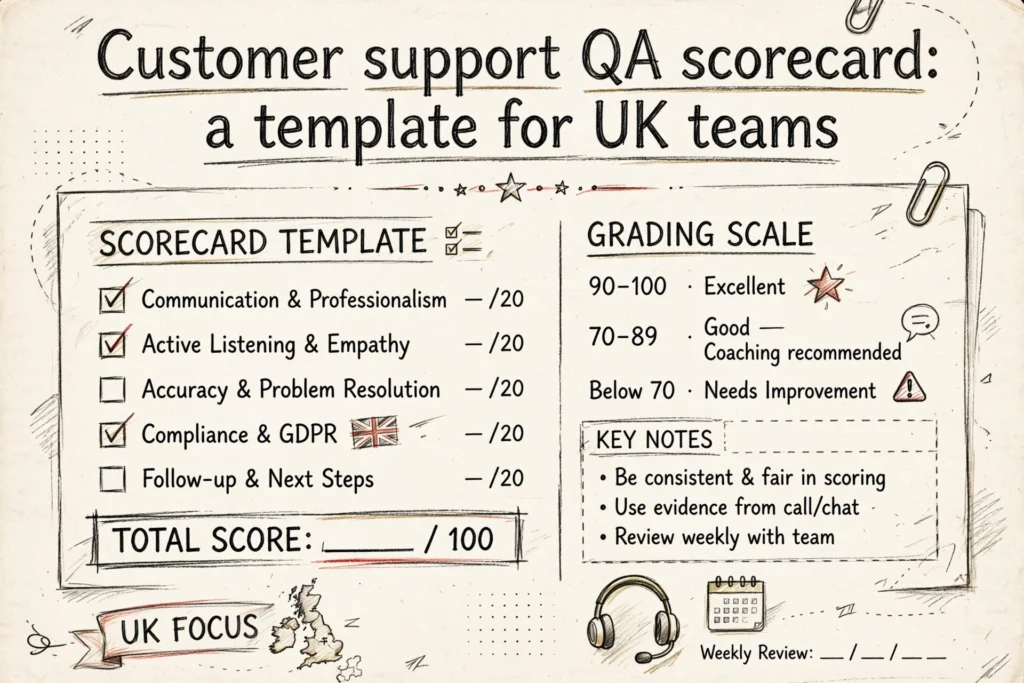
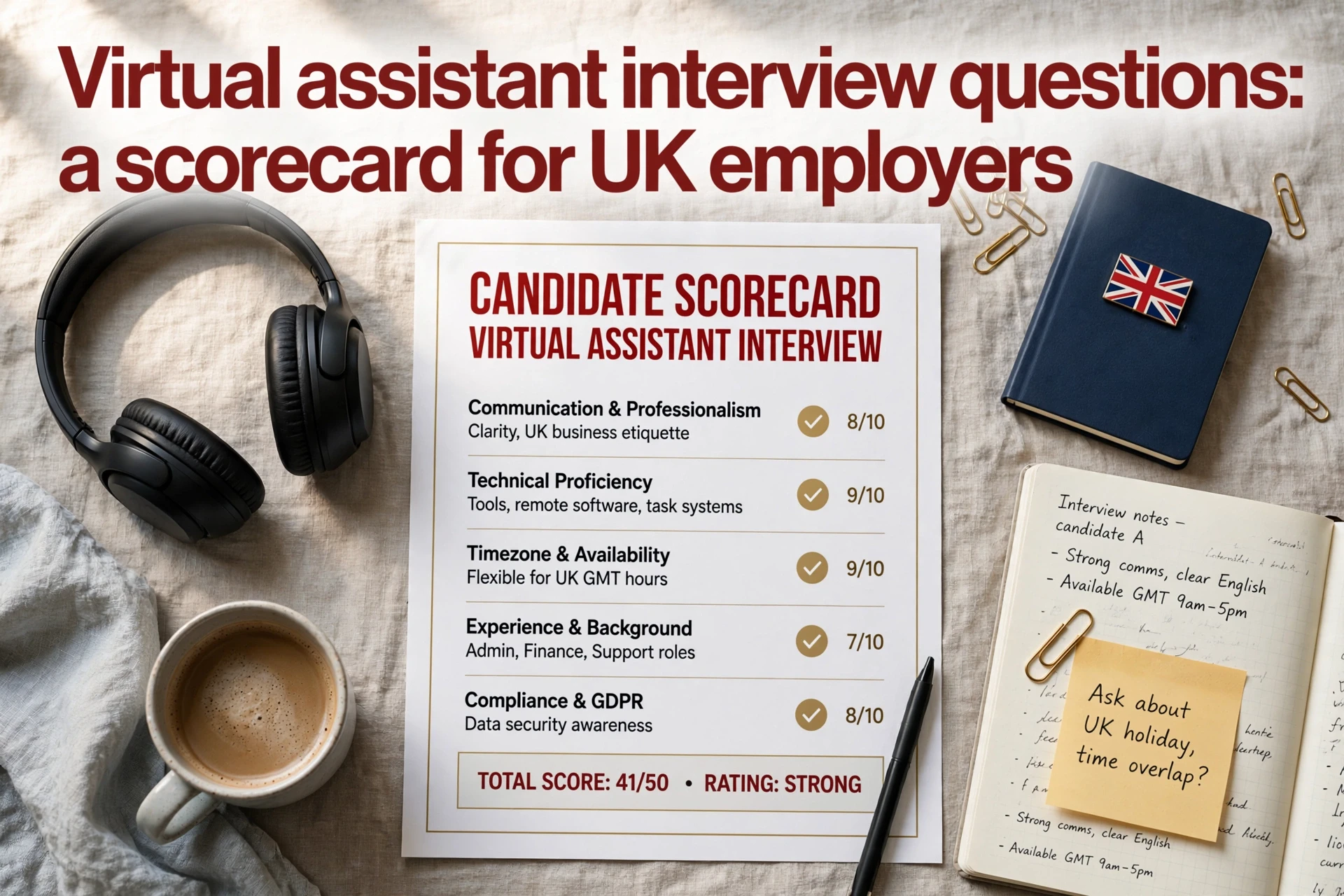
Copyable interview scorecard
Candidate reference: [ ]; interviewer: [ ]; date: [ ]; role/version: [ ].
| Capability | Score 1–5 | Evidence from answer or exercise | Follow-up needed |
|---|---|---|---|
| Prioritisation | [ ] | [ ] | [ ] |
| Written communication | [ ] | [ ] | [ ] |
| Discretion | [ ] | [ ] | [ ] |
| Ownership | [ ] | [ ] | [ ] |
| Technical confidence | [ ] | [ ] | [ ] |
| Total /25 | [ ] | Decision and reasons: [ ] | [ ] |
Record any essential requirement separately. A high total should not obscure a material concern about handling confidential information.
Step 4: Run a Fictional Inbox and Diary Skills Assessment
Use a short work sample to collect evidence alongside interview answers. Give every candidate the same fictional materials and 30-minute task, explain how it will be assessed, and agree appropriate adjustments in advance. Do not ask candidates to process live customer information or complete productive client work.
Give the candidate this fictional scenario
Read this out or paste it into the chat, then let them work:
It is 9:15am UK time. You support Sarah, a director. Her calendar shows a client call at 11:00, double-booked with an internal meeting from 10:30 to noon. A supplier has emailed to cancel a delivery booked for tomorrow. Sarah’s phone is off and she is in meetings until noon. A second email asks for a signed invoice today. A colleague has also asked you to chase a hotel booking for next week.
Then ask the candidate to reply with three things: which task they handle first and why, a short draft email to the supplier, and how they would brief Sarah at noon. Watch for one habit above all: good assistants make sensible assumptions, state them clearly, and never invent facts. The same scenario works for inbox management and diary questions, so you can adapt it for EA or admin roles.

Score the work sample for decisions and handover quality
Use these checks as evidence for the five-capability scorecard. The exercise is not an extra sixth score:
- Prioritisation: Did they flag the 11:00 call conflict first?
- Communication: Is the draft email short, clear and polite?
- Handover: Can Sarah act on their summary in 30 seconds?
Also Read: Professional Services
Step 5: Make and Record the Selection Decision
Use a worked evaluation record
Score candidates independently before the panel discusses them. Compare the recorded evidence and resolve differences against the written anchors.
Here is a fictional worked example (illustration only):
| Candidate | Prioritisation | Communication | Discretion | Ownership | Technical confidence | Total /25 | Decision |
|---|---|---|---|---|---|---|---|
| Candidate A | 4 | 5 | 4 | 4 | 3 | 20 | Progress, subject to remaining checks |
| Candidate B | 3 | 4 | 4 | 3 | 4 | 18 | Reserve |
| Candidate C | 2 | 3 | 5 | 2 | 3 | 15 | Do not progress for this brief |
These fictional decisions illustrate the record, not a universal pass mark. Write your threshold and essential requirements before interviewing. If candidates tie, use further equivalent job-related evidence and record why it changed the decision.
Brief the next step without confusing employment responsibility
Once you choose, confirm the brief, agreed hours and reporting line. Hire SA Talent introduces UK businesses; SA Konexion delivers recruitment and employment services under the agreed arrangement. Confirm the legal employer and each party’s responsibilities in your contract. The virtual assistant hiring page explains the next step, while our remote team management guide supports onboarding.
To discuss a VA brief, contact Hire SA Talent with the responsibilities and assessment criteria you have agreed.
Frequently Asked Questions
Which questions should I ask a virtual assistant candidate?
Ask for examples of competing deadlines, unclear instructions, confidential requests and follow-through. Use the same core questions for every candidate and score the evidence against the actual job.
How do I calculate the interview score?
This template scores five capabilities from 1 to 5, giving a total out of 25. Record a reason for each score and set essential requirements and the decision threshold before interviewing.
How long should the practical assessment take?
The fictional exercise here takes 30 minutes. Explain the task and assessment in advance, agree appropriate adjustments and use invented information rather than live customer records.
Does a work sample replace the interview?
No. Use it alongside the interview and other relevant recruitment checks. Record which capability each piece of evidence supports rather than counting the same result twice.
Conclusion
Keep the role brief, questions, scoring anchors and exercise together as one versioned assessment. Use it consistently, record relevant evidence and retain candidate information according to your recruitment privacy policy. The aim is a clear, explainable decision about the work this particular role requires.