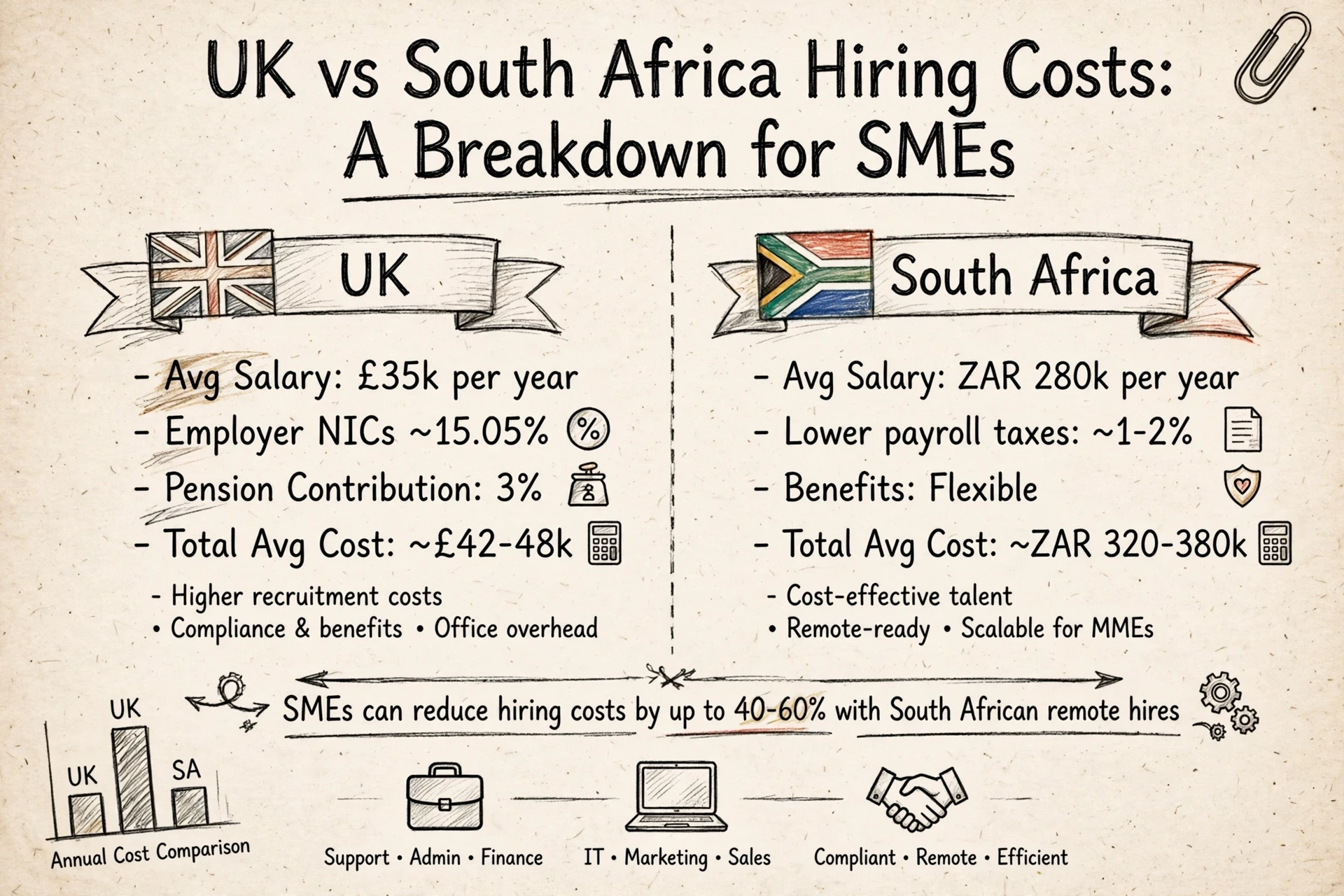
Quick Summary: Hiring South African remote staff through an employer of record can cut fully loaded costs by 30% to 60% for support, admin, bookkeeping, sales and marketing roles, while UK employer National Insurance and pension add roughly 18% to 20% to salaries. The saving is smaller for scarce specialist roles and can disappear once recruitment, employer-of-record fees, onboarding, equipment, currency changes and attrition are included, with about one in five SMEs seeing no final benefit. UK hiring remains better for roles needing physical presence, regulated UK work or immediate availability, so SMEs should model total employment costs and pilot one hire for three months before scaling.
A UK customer support lead costs roughly GBP 28,000 to GBP 34,000 in base salary once employer National Insurance and pension contributions are added. The equivalent South African hire often lands between GBP 12,000 and GBP 18,000 fully loaded. That gap makes remote hiring look like the obvious route to cost efficient staffing, but it is not the whole arithmetic. For roughly one SME in five, the saving evaporates once recruitment fees, employer-of-record charges, ramp-up time and attrition are priced in.
Most UK small businesses face the same dilemma: add capacity while budgets stay flat, with salary figures in ZAR and GBP and no clear view of which numbers actually drive the total cost of employment. This article builds that model layer by layer for both locations, then maps role-by-role economics and gives you a framework for picking the right side.
UK vs South Africa Hiring Costs: Side-by-Side Comparison
| Hiring in the United Kingdom (direct UK employment) | Hiring in South Africa (remote, via a compliant employment route) | |
|---|---|---|
| Base salary for equivalent roles | Highest of the two markets; support and admin roles typically GBP 24,000 to GBP 32,000 base | Typically 30% to 60% below UK rates for general roles, narrower for scarce technical skills |
| Employer statutory on-costs | Employer NIC 15% above the GBP 5,000 secondary threshold from 6 April 2026, plus auto-enrolment pension from a GBP 10,000 earnings trigger | PAYE plus employer UIF at 1% and SDL at about 1% of payroll, with VAT at 15% on service fees |
| Recruitment and onboarding cost | Direct hiring costs mostly internal time; agency and role-specific fee structures add a percentage of first-year salary | Marketplace or specialist recruitment fees plus employer-of-record setup, typically a monthly fee per employee plus a one-off onboarding charge |
| Time to productive work | Typically 2 to 6 weeks for in-demand local roles, longer where niche skills are required | Commonly 2 to 4 weeks from brief to start, plus a structured onboarding period for systems and process access |
| Employment risk and compliance load | Managed by the UK employer directly; upcoming Employment Rights Act 2025 reforms increase the cost of UK employment | Shared with the employer-of-record partner, covering BCEA contracts, payroll, UIF, SDL and IRP8/EMP201 reporting |
| Best fit for | Time-critical hires, leadership roles, roles needing UK client presence or face-to-face delivery | Support, admin, finance back-office, sales development, marketing and IT operations roles with UK-overlapping hours |
How UK and South Africa Hiring Compare
Hiring in the United Kingdom (direct UK employment)
Direct UK employment means hiring on PAYE with auto-enrolment pension and employer National Insurance on top of the highest base salaries in this comparison. It suits time-critical hires, leadership roles and any job needing UK client presence, but the employer carries all compliance directly under upcoming Employment Rights Act 2025 reforms.
Hiring in South Africa (remote, via a compliant employment route)
Hiring South African remote staff under South African law offers cost-efficient staffing: bases typically sit 30% to 60% below UK rates, with PAYE, UIF and SDL contributions plus employer-of-record fees layered on. It fits support, admin, finance, sales, marketing and IT roles needing UK-overlapping hours, with compliance shared through the employer-of-record partner.
Salary Levels: The Starting Point of Any Comparison
Base salaries set the tone for the whole comparison. For equivalent roles, South African pay typically sits 30% to 60% below UK rates. How much you save depends less on the country and more on the role family you are hiring for.
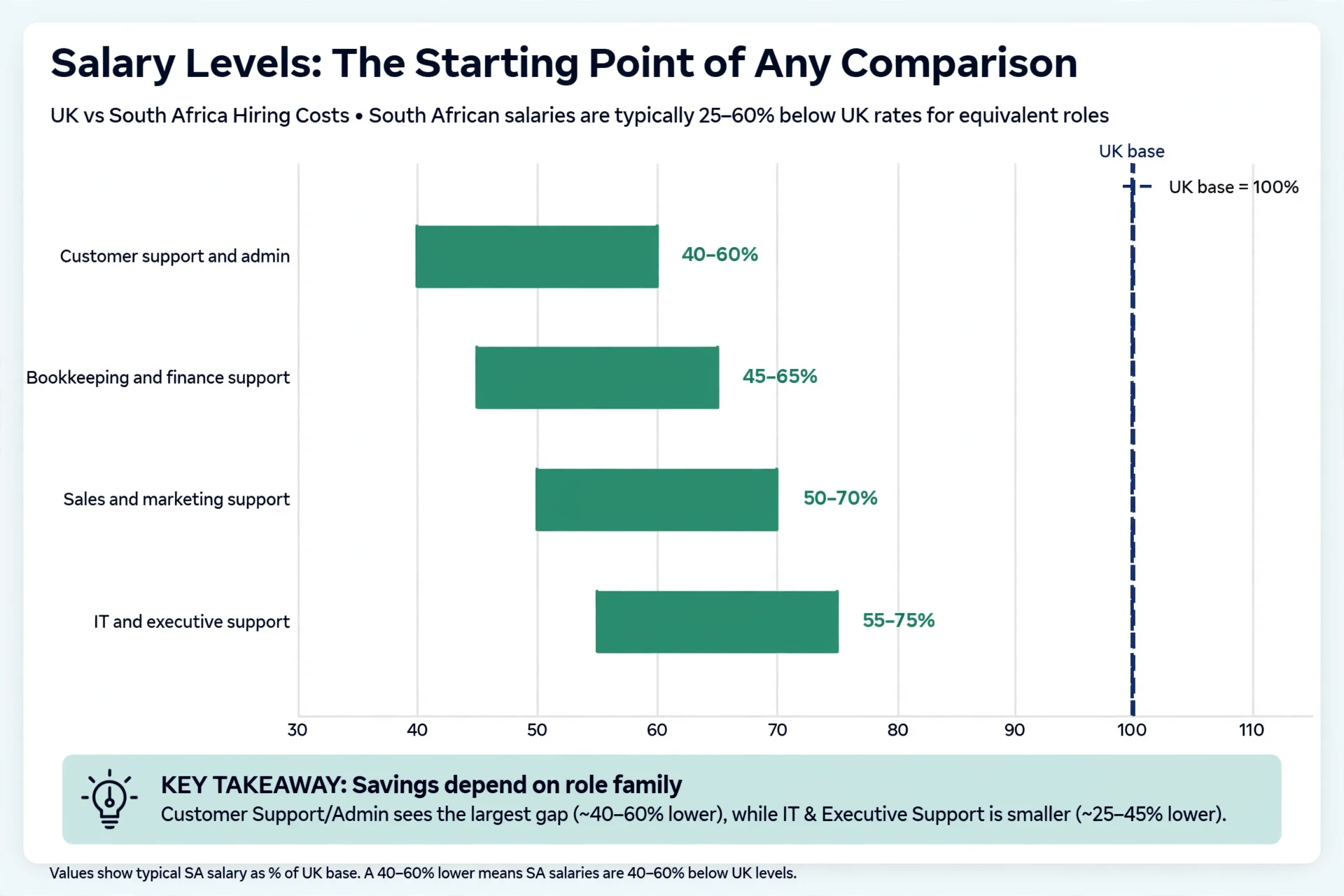
| Role family | Typical differential vs UK base |
|---|---|
| Customer support and admin | 40% to 60% lower |
| Bookkeeping and finance support | 35% to 55% lower |
| Sales and marketing support | 30% to 50% lower |
| IT and executive support | 25% to 45% lower |
Generalist versus specialist roles: where the differential widens and narrows
The gap is widest for generalist work. A VA, support agent or bookkeeper in South Africa costs a fraction of a UK equivalent, and the quality pool is deep.
It narrows for scarce specialist skills. Senior developers, data engineers and experienced finance leads command strong pay in both markets, so a South African hire may save 25% to 40% rather than half. Percentage claims from providers often quote the generalist end, so match the role before you trust the number.
Cost of living, currency exposure and why percentages mislead
Percentages flatter the saving because they ignore rand volatility. Salaries are set in rand, so a weaker pound shrinks your discount overnight. Budget a currency buffer of 5% to 10% and model costs in pounds at a conservative exchange rate. For full role-by-role rates, a South Africa salary guide for UK employers gives the dependable baseline that percentages alone cannot. For a broader view of costs, see the guide to hiring staff in South Africa versus the UK, including 2026 figures. For a broader view of costs, see the guide to hiring staff in South Africa versus the UK, including 2026 figures.
Employer On-Costs: What Each Country Adds On Top of Salary
UK on-costs in 2026/27 add roughly 18% to 20% to salary for most hires. South Africa adds about 2% plus employer PAYE withholding, which is a tax the employee carries, not an employer cost. That gap is where much of the saving sits.
| On-cost | UK (2026/27) | South Africa |
|---|---|---|
| Statutory employer charge | Employer NIC 15% above the GBP 5,000 secondary threshold | UIF 1% employer share, SDL 1% of payroll |
| Pension | Auto-enrolment pension, 3% employer minimum from a GBP 10,000 trigger | None required, though provident funds are common |
UK employer National Insurance and pension costs for 2026/27
The two big additions are employer National Insurance and pension. From 6 April 2026 you pay 15% NIC on earnings above the GBP 5,000 secondary threshold, per HMRC’s employer rates for 2026/27. Auto-enrolment adds a 3% employer pension minimum once a worker earns GBP 10,000 or more, so a GBP 28,000 salary carries roughly GBP 5,000 in on-costs.
South African PAYE, UIF, SDL and what employers actually pay
South Africa looks heavier on paper but is lighter in practice. PAYE is deducted from the employee’s pay and passed to SARS, so it is not an employer cost. You add 1% UIF and 1% SDL, as PwC’s South Africa tax summary sets out. That is about 2% on most payrolls, and if you hire through an employer of record the provider handles it. The PAYE, UIF and SDL process for UK employers is straightforward once mapped.
Recruitment, Onboarding and the Cost of the Employment Route
Hiring costs more than salary. Recruitment fees, employment route charges and setup costs all land in your first year, and they differ sharply between the two markets.
Recruitment fees: agency percentage versus fixed-fee specialist search
UK agencies typically charge 15% to 20% of a hire’s first-year salary, and up to 30% for hard-to-fill roles, according to Agency Central’s fee guide. On a GBP 30,000 support role, that is GBP 4,500 to GBP 6,000 before the person starts. Specialist searches for South African remote staff usually run on fixed fees instead, so you know the cost before you commit.

Employer-of-record and payroll administration fees
If you hire in South Africa without a local entity, an employer of record becomes the legal employer and handles PAYE, UIF and SDL for you. Expect a monthly per-employee fee rather than a large upfront charge. The employer of record cost breakdown from Hire SA Talent shows how these fees compare across providers, so you can budget the full employment route.
Onboarding and equipment overhead for remote staff
Remote hires need kit and access. Budget for a laptop, headset, software licences and secure connections, often GBP 500 to GBP 1,000 upfront. South African time zones also overlap with UK hours, so induction can run in normal working time rather than evenings. Build onboarding days into your cost model, because time to productive work is a real expense. This is where cost efficient staffing is won or lost: a cheap hire that takes three months to ramp up is rarely cheap.
Choosing an Employment Model: Direct Contract, Contractor or Employer of Record
Do UK businesses need their own South African entity to hire staff? No. You have three compliant routes: set up a local entity and hire directly, engage the person as a contractor, or use an employer of record that employs them for you. Most UK SMEs should rule out the first route on cost alone, because an entity means registration, payroll, tax filings and ongoing legal duties in a foreign jurisdiction.
Why contractors carry hidden cost for a UK client
A contractor looks cheap until you check the rules. South African law looks at who controls the work, and many “independent” contractors actually fail the independence tests, which makes them employees under SARS guidance. Misclassification exposes you to back taxes, penalties and unfair dismissal claims, none of which sit in your budget line.
There is also the practical drag. Contractors invoice in rand, chase their own tax, and can walk away with your client relationships and processes. If your contractor costs you a year of salary equivalent by paying contractors who then quit, you have saved nothing. For a team member you want working five days a week, embedded in your systems, employment via an employer of record usually wins.
What an employer-of-record fee actually buys
An employer of record already runs a registered South African entity, so it hires your chosen person under a compliant local contract. It handles PAYE, UIF and SDL filings, employment contracts, leave tracking and dismissal procedure. Your total cost of employment lands in one predictable monthly invoice.
Expect the fee to add roughly 8% to 15% on top of the gross salary, depending on provider and support level. Compare that against the cost of getting South African tax law wrong, which is rarely below the first-year fee. A UK-focused provider such as Hire SA Talent can also run structured onboarding and time-zone aligned management, so the hire becomes productive faster.

That fee is the reason most SMEs choose this route over entity setup or contractor risk.
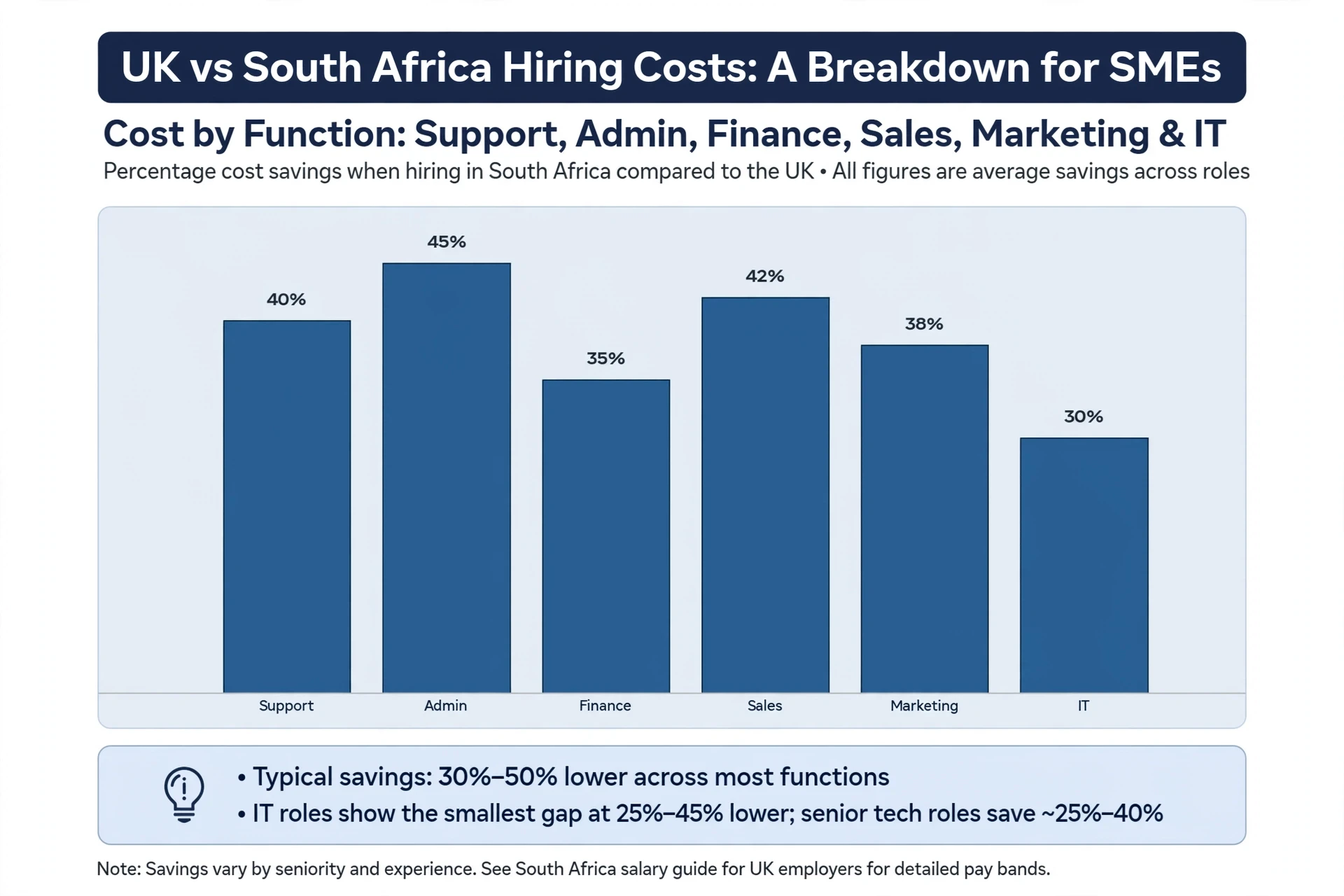
Cost by Function: Support, Admin, Finance, Sales, Marketing and IT
Support and customer service roles show the widest gap. South African support staff cost 40% to 60% less than a UK equivalent, partly because the earlier UK figure of GBP 28,000 to GBP 34,000 base sits well above South African pay for the same workload. You still get strong English and time-zone overlap.
Virtual assistant and admin hires follow a similar pattern. An executive assistant who manages inboxes, calendars and travel from Johannesburg or Cape Town typically costs half of a London equivalent. Savings here are consistent because the work is process-driven and skills transfer cleanly.
Bookkeeping and finance admin sit in the middle, at 35% to 55% lower. Sales and marketing support, from CRM upkeep to campaign admin, comes in 30% to 50% below UK rates. For details on pay bands, see the South Africa salary guide for UK employers.
IT support and systems admin show the smallest gap, 25% to 45% lower. Senior developers and cloud engineers command strong pay in both markets, so model a 25% to 40% saving rather than half.

Roles in demand, including IT support and finance admin, are covered in depth on Hire SA Talent’s own role pages.
Hidden Costs, Retention and the Changing Cost of UK Employment
Attrition, time-to-productivity and the true cost of turnover
Advisers such as ACAS put the cost of replacing an employee at well over the leaver’s annual salary once you add recruitment fees, onboarding and the weeks of lost output. Replacing a GBP 30,000 support hire can therefore cost GBP 15,000 to GBP 30,000 in real terms. Remote South African staff often stay longer because the roles are scarce and valued locally, which means fewer replacements to fund. Good remote team management and structured onboarding cut time-to-productivity, typically two to four weeks, closer to the fast end.
The UK’s Employment Rights Act 2025 and the rising floor cost of UK hiring
The Employment Rights Act 2025 raises the cost and risk of every UK hire. Day-one unfair dismissal rights, extended statutory sick pay and new probation rules all lift the true cost of hiring staff in the UK, because you carry the risk and the admin directly. Since employer on-costs already add 18% to 20%, the floor keeps rising. When a role is client-facing or needs a physical presence, hiring locally still wins. For remote operational support, compare total costs before defaulting to the UK market.
Best Cost-Effective Hiring Options for UK Businesses
What are the best cost-effective hiring options for UK businesses? Ranked from cheapest to most flexible:
- Part-time South African remote staff, hired through an employer of record, for 15 to 25 hours a week of support or admin work
- Full-time South African hires in customer support, bookkeeping, sales, marketing or IT, where pay runs 30% to 60% below UK rates
- UK part-time or fixed-term local hires, best when the role needs to sit in the office or handle regulated UK work
- UK full-time hires, the right answer for senior or site-dependent roles
How do you structure a first pilot hire? Start with one role, one person and a three-month window. Pick a task-heavy job like support or bookkeeping, write down the outcomes you expect, and measure output weekly rather than hours logged. Track three numbers: cost per task, response times and how long the person takes to reach full speed. If savings hold after month three, scale to the next role. This kind of cost-efficient staffing works best when you test it small before committing to a full team.
Which Should You Choose: UK or South Africa Hiring?
The right answer depends on the role, not the trend. When should a UK business hire locally instead of hiring in South Africa?
- The role needs daily in-person presence or regulated UK-signed work
- Senior specialist skills put the pay gap under about 25%
- You need someone startable tomorrow with no onboarding runway
- Headcount is one, and setup cost would outweigh the saving
When hiring in South Africa is the right call
Choose South Africa when the role is remote-friendly and repeatable: customer support, admin, bookkeeping, sales and marketing support, IT helpdesk and executive assistance all fit. For these roles, fully loaded South African costs often run 30% to 60% below UK equivalents, and the time zone overlap means your hire works UK hours. If you want cost-efficient staffing without opening an entity, a structured hiring route that introduces vetted candidates and manages local employment keeps things compliant. The salary guide for South African pay rates for UK employers helps you benchmark each role.
When the UK local hire is the right call
Hire locally when proximity carries real value. Client-facing roles that demand office presence, senior engineers and finance leads where savings shrink to 25% to 40%, and positions the Employment Rights Act 2025 makes costly to get wrong, all argue for a UK contract. One-off or short projects can also suit a UK freelancer instead. If total cost of employment is close, the simpler local hire usually wins, because it removes currency risk and cross-border admin.
If your numbers show UK hires costing nearly double for the same roles, compare candidates through Hire SA Talent. You get vetted South African staff in support, admin, finance, sales, marketing and IT through a structured, compliant route, so the savings in this model actually reach your bottom line.
Frequently Asked Questions
Q1: What are the best cost-effective hiring options for UK businesses?
Part-time South African remote staff via an employer of record offer the best cost-efficient staffing for support and admin work, cutting fully loaded costs by 30% to 60% versus UK equivalents.
Q2: How much does an employer of record in South Africa charge?
Typically 8% to 15% on top of gross salary, charged monthly per employee, plus a one-off onboarding fee.
Q3: Is hiring a South African contractor cheaper than an employer of record?
Rarely. Misclassification risks back taxes and penalties, so a compliant employment route usually wins.
Q4: When should a UK business hire locally instead?
When the role needs office presence, regulated UK work, or the pay gap falls below 25%.
Q5: How much do UK employer on-costs add in 2026/27?
Roughly 18% to 20%: 15% NIC above the GBP 5,000 threshold plus a 3% auto-enrolment pension minimum.
Conclusion
The numbers come down to role type, not geography. UK hires carry 18% to 20% in employer National Insurance and pension on top of the highest salaries, and the Employment Rights Act 2025 keeps lifting that floor. South African staff, hired through an employer of record, run 30% to 60% lower fully loaded for support, admin and finance work, though attrition, onboarding and fees eat into it. For roughly one SME in five, the saving disappears. Run the total cost of employment model, test one role for three months, and treat outsourcing to South Africa as cost-efficient staffing only where the maths holds.