
Quick Summary: South African remote vacancies hit a record high, rising 28% year on year as UK firms hire more support, finance, sales, marketing and IT staff through an employer of record. Hire SA Talent helps recruit these candidates, while the EOR handles contracts, payroll and South African compliance without requiring a local entity. UK businesses should compare all-in costs, typically $300 to $600 per employee monthly plus 10% to 15% in statutory contributions, and plan for one to three weeks to hire.
UK demand for an employer of record South Africa route has hit a record first-half 2026 pace. Pnet’s July 2026 Job Market Trends Report puts South African remote vacancies at their highest level on record, up 28% year on year and 41% over two years. The catch is that demand alone proves nothing. You still need to pick a provider, price a compliant contract and know the full employer of record South Africa cost before you commit. Most of what is written on this is generic or unverifiable. This guide works through what the 2026 data shows, which EOR providers deserve a shortlist, what fees really add up to, and the checks to make before you sign.
Record Remote Hiring Demand Is Pulling UK Buyers Toward Employer of Record South Africa Routes
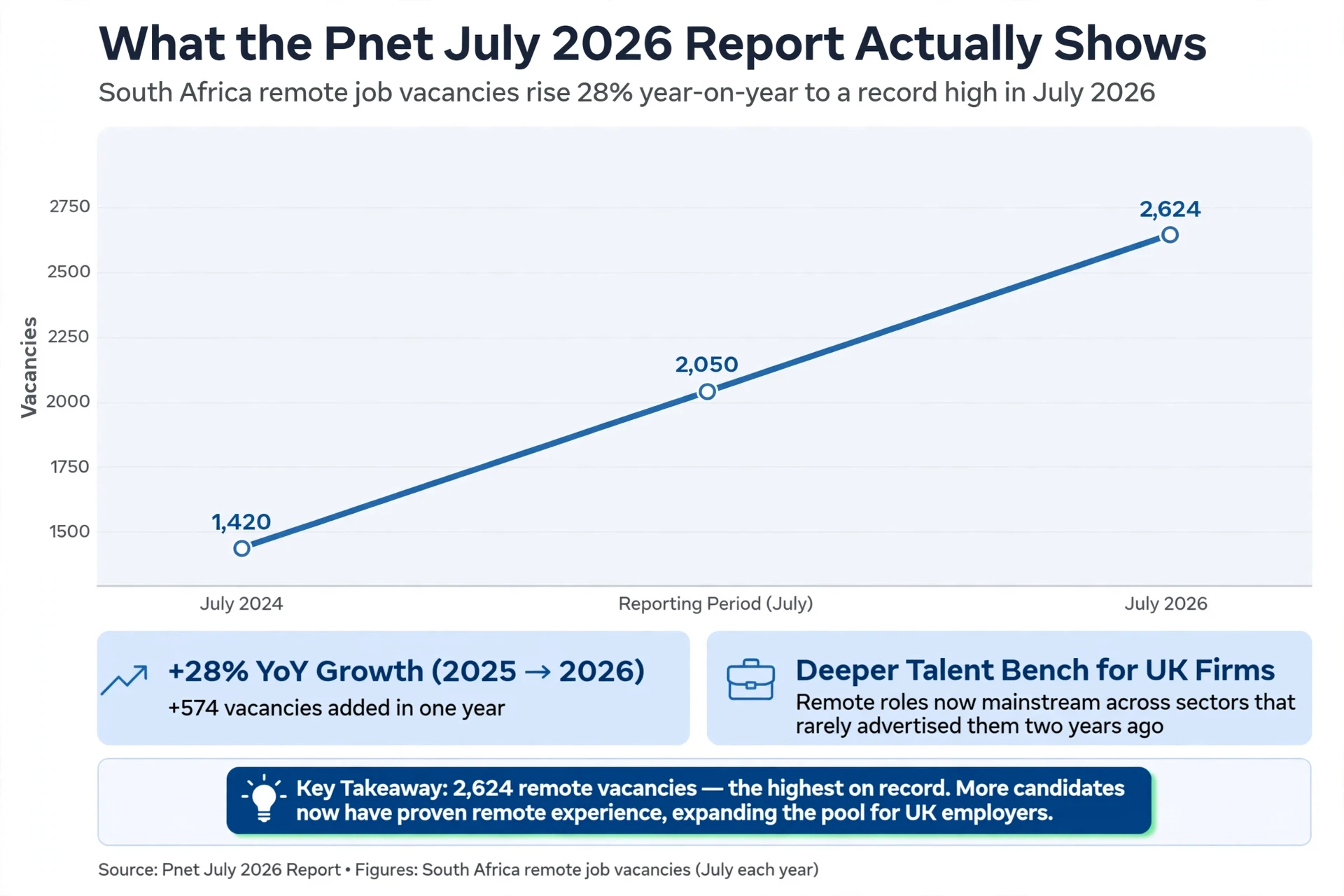
UK hiring managers are asking one question more than any other in 2026: what is driving this surge in South African remote hiring? The answer sits in the data. Advertised remote opportunities in South Africa have hit their highest level on record, up 28% year on year and 41% over two years, and most of the new demand comes from commercial roles, not just IT. More UK firms now want to hire that talent without opening a South African entity, which is exactly what the employer of record South Africa route delivers.
What the Pnet July 2026 Report Actually Shows
Pnet’s July 2026 Job Market Trends Report found that remote work opportunities in South Africa have reached their highest level to date. The report describes remote work as going mainstream: flexible roles now appear across sectors that barely advertised them two years ago. For UK buyers, the headline number matters less than the trend line. A 28% rise in a single year means more candidates with proven remote experience, and a deeper bench to hire from.
Why Growth Has Spread Beyond IT Into Finance, Support and Sales
The 2026 growth is broad. Finance, customer support and sales support roles now make up a large share of new remote listings, alongside the developers that led earlier waves. UK SMEs noticed. A South African bookkeeper, virtual assistant or support agent works overlapping UK hours, speaks fluent English and costs a fraction of an equivalent London hire. We wrote more about this in our Pnet data explained breakdown.
Why a Vacancy Spike Still Needs a Compliant Route
Demand alone does not make hiring simple. A UK firm cannot legally employ someone in South Africa without a local entity or a registered employer of record that runs PAYE, UIF and SDL on its behalf. Getting that structure right is what turns the opportunity into a hire.
Which Employer of Record Providers in South Africa Are Worth Shortlisting
Dozens of providers now offer the employer of record South Africa route, and they are not interchangeable. The best EOR providers in South Africa for UK companies share three traits: a flat, published fee; proof they employ staff directly in South Africa rather than through partners; and fast onboarding for commercial roles like virtual assistants, bookkeepers and customer support staff.
The Three Questions That Separate Providers
Ask each provider the same three questions before anything else. First, who is the legal employer: your provider, or a local partner it subcontracts to? A direct employing entity gives you one accountable party. Second, what does the monthly fee cover? You want statutory charges such as PAYE, UIF, SDL and COIDA itemised separately from the service fee. Third, how quickly can a hire start? Good providers place a support or finance hire in two to three weeks. Vague answers here are a reason to walk away.
How to Read a Quote Without Getting Burned
Compare quotes on total monthly cost, not the headline fee. Most providers charge $300 to $600 per employee per month, according to Atlas HXM, but cheaper quotes sometimes exclude the employer’s statutory contributions, which the invoice adds later. Ask for one all-in figure covering salary, employer charges and the fee. We break down a full example in our EOR cost guide.

Where UK Buyers Can Go Deeper Before Shortlisting
Deel, Oyster, Remote and local specialists such as GeminiWorx and dna-eor all serve UK firms, so shortlist against your own needs rather than marketing claims. Match provider strengths to role type: global platforms suit IT hires, while local specialists often place bookkeepers and executive assistants faster.
What an Employer of Record in South Africa Actually Costs a UK Business
An employer of record in South Africa typically costs a UK business $300 to $600 per employee per month in fees, plus the employer’s statutory contributions, which usually add roughly 10% to 15% on top of gross salary. The catch is that some quotes show only the first number.
| Cost layer | What it covers | Typical size |
|---|---|---|
| EOR fee layer | The provider’s monthly charge for contracts, payroll and compliance | $300 to $600 per employee per month |
| Statutory layer | Employer PAYE administration, UIF, SDL and COIDA contributions | Roughly 10% to 15% of gross salary |
| Salary layer | The employee’s gross pay, set by role and market rates | Paid directly through the provider |
The fee layer buys the admin. The statutory layer is what an employer must legally pay, and it belongs on your budget from day one. When you compare providers, ask for both layers in writing so your employer of record cost forecast matches the invoice.
The Costs Providers Do Not Publish
Some quotes exclude the employer’s UIF, SDL and COIDA lines, so the advertised fee looks lower than the real one. Others add one-off charges for onboarding, offboarding or forex conversion that only appear on the invoice.
Three questions expose the gap:
- Does the fee include employer statutory contributions, or are they billed separately?
- What are the setup and termination charges?
- Who covers the currency conversion margin on salary payments?
Deel, Remote and Oyster publish headline rates, but the published figure rarely tells the whole story. Ask for a worked example using your actual salary before you sign anything.
The Roles UK Firms Are Hiring Through an Employer of Record in South Africa Right Now
The 28% surge in remote vacancies is not spread evenly across the board. UK firms are hiring in two clear clusters: a deep pool of support and administrative roles, and a faster-growing set of finance, sales, marketing and IT positions. Both can be staffed through an employer of record, and the roles UK businesses hire for span all seven of these functions.
Support and Administrative Roles Are the Deepest Pool
Virtual assistants, customer support agents, bookkeepers and executive assistants dominate current hiring. Job boards list hundreds of these openings aimed at UK employers, from remote assistant roles serving UK companies to customer support positions on local boards.
The pool is deep because these roles suit South Africa’s strengths. English is a business language, the time zone overlaps UK working hours, and salaries are far below London equivalents. A UK SME can hire an experienced VA or support agent for a fraction of a domestic salary, with the employer of record handling PAYE, UIF and SDL so the worker is properly employed from day one.

Finance, Sales Support, Marketing and IT Are Scaling Fastest
The newer demand sits in bookkeeping, sales support, marketing execution and IT helpdesk work. UK firms now expect these hires to embed with in-house teams, not sit in a separate outsourced unit. That shift favours direct employment through an EOR over agency models, because the UK business keeps daily control while the provider carries the South African employing duties.
Compliance and Timeline Checks Before a UK Business Signs
EOR onboarding in South Africa usually takes about one to two weeks end to end: provider setup and contract drafting in one to five days, then employee documentation in two to five days, according to Atlas HXM’s hiring timeline. The real delay is rarely the paperwork. It is the candidate’s notice period, which runs one week per year of service for the first six months under the Basic Conditions of Employment Act, then four weeks after that. A great finance or support hire can sit out a month before day one, so plan your start date around it.

Check the provider’s stated onboarding window against your project dates. If a role is urgent, ask which candidates have short or expired notice periods. For a structured view of what happens after signing, see this guide to managing a South African remote team onboarding.
EOR or PEO: Which Structure Are You Actually Buying
You need an employer of record to hire in South Africa without an entity. An EOR is the legal employer: it runs the contract, payroll and local compliance. A PEO only works alongside an entity you already own, so it does not solve your problem if you have none. Some providers use the terms loosely, so confirm in writing that the provider, not a shell you must set up, holds the employing entity.
Statutory Obligations the Employer Inherits
Whoever is the legal employer carries PAYE administration, UIF, SDL and COIDA contributions, plus the national minimum wage. Ask the provider to show these as separate lines on the quote, since bundles that hide them often leave you with surprise costs. Confirm dismissal handling too, because South African labour law makes ending employment slower than in the UK.
How UK Employers Actually Engage a South African EOR
Who Introduces and Who Employs
The route to hiring South African staff from the UK involves two parties with distinct roles. Hire SA Talent introduces UK businesses to vetted candidates across support, admin, finance, sales, marketing and IT roles, handling the recruitment and matching side. The EOR provider then becomes the legal employer in South Africa, issuing a compliant local contract, running PAYE, UIF, SDL and COIDA contributions, and managing payroll in rand. Your business directs the work day to day, but the employment sits with the local entity or partner. This split keeps you out of UK sponsor licence territory and keeps the worker fully compliant with South African employment law. Never assume one provider covers both halves.
A Practical Sequence From Brief to First Day
Most engagements follow the same pattern. First, you send a role brief covering duties, UK working hours and salary range. Second, shortlisted candidates are interviewed and you choose. Third, the EOR drafts the South African contract and registers the employee for statutory contributions. Fourth, equipment, email access and data permissions are set up. Expect one to three weeks from signed brief to first day, depending on notice periods. Practical prep, such as a clear escalation matrix for IT support roles or an inbox delegation plan for an executive assistant, makes the first fortnight far smoother.
How South Africa Became the Default UK-to-Africa Hiring Route
South Africa now takes the biggest share of UK hiring across Africa, and the reason is practical. English is a working language, the time zone sits within an hour or two of London, and salaries run well below UK rates. The 41% rise in remote vacancies over two years has deepened the talent pool too, so UK firms can hire customer support, bookkeeping and marketing staff with proven remote experience.
An Underserved Market Catching Up
For years, UK employers overlooked South Africa in favour of the Philippines and India. That has changed. Time zone overlap means a virtual assistant or finance clerk works the same hours as your UK team, not a night shift. Strong internet in major cities and a large pool of degree-qualified candidates make commercial roles viable. Firms comparing outsourcing to South Africa with other regions usually find the cost gap is now smaller than the practical gap.
Why Employers Chose an Employer Rather Than an Entity
Setting up a South African subsidiary costs thousands and takes months. An employer of record handles contracts, PAYE, UIF and SDL for a monthly fee, so most UK firms hire through one within weeks. Providers such as Deel, Remote and Oyster serve this market, and the options are compared in the best employer of record companies for July 2026.
UK hiring costs keep climbing, so the smarter move is a South African hire that stays legal from day one. Hire SA Talent connects you with vetted remote staff across support, admin, finance, sales, marketing and IT. See how it works at Hire SA Talent and get your first role scoped this week.
Frequently Asked Questions
Q1: Who are the best EOR providers in South Africa?
Shortlist providers with a flat published fee, a direct South African employing entity, and two to three week onboarding. Deel, Oyster, Remote, GeminiWorx and dna-eor all serve UK firms, but match strengths to role type before you commit.
Q2: What does an employer of record in South Africa really cost?
Expect $300 to $600 per employee per month in fees, plus statutory contributions adding roughly 10% to 15% of gross salary. Always ask for one all-in monthly figure covering salary, employer charges and the service fee.
Q3: How long does EOR onboarding take in South Africa?
One to two weeks end to end. The real delay is usually the candidate’s notice period, which can run up to four weeks under the Basic Conditions of Employment Act.
Q4: Can I hire South African staff without a UK sponsor licence?
Yes. The EOR is the legal employer in South Africa, so no UK sponsor licence applies and the worker stays compliant with local employment law.
Q5: Do I need an EOR or a PEO?
You need an EOR. A PEO only works alongside a South African entity you already own, so it cannot replace one if you have none.
Q6: Which roles do UK firms hire through a South African EOR?
Virtual assistants, customer support agents, bookkeepers, sales support, marketing and IT staff, plus executive assistants. Support and admin roles offer the deepest pool of remote-experienced candidates.
Conclusion
The 2026 data gives UK firms a clear case: South African remote vacancies are up 28% year on year, the talent pool reaches well beyond IT into bookkeeping, support and sales roles, and an employer of record South Africa route lets you hire without an entity. The three decisions that matter are provider choice, all-in monthly cost and compliance checks. Insist on a flat fee with PAYE, UIF and COIDA shown separately, confirm who holds the employing entity, and plan start dates around notice periods. Firms that do this hire within one to three weeks, with the worker fully employed and your business directing the day-to-day work.