
Quick Summary: Hiring the same role in South Africa instead of the UK typically costs 55% to 65% less, mostly because UK employers pay 15% NIC on top of salary while SA statutory contributions sit near 2%. A £60,000 all-in customer support role in Manchester lands between £17,000 and £22,000 from Johannesburg, with GMT+2 still covering the UK working day. The article recommends using a six-input cost calculator, budgeting for kit, management time, leave cover and rand movement, and routing hires through an employer of record until headcount passes about five, reserving UK hiring for roles that genuinely need physical presence or same-hours overlap.
A UK finance lead budgeted £52,000 for a customer support hire in Manchester, then found the real employer cost near £60,000 once 15% employer NIC, pension, kit and recruitment fees stacked up. The same role run from Johannesburg usually lands between £17,000 and £22,000 all in. The gap is real, but only when you cost it properly.
Most UK SMEs comparing the two markets meet the same wall: every source quotes a different number, and nobody says which costs are legally required on each side. A reliable South African employment cost calculator changes that. This guide gives you a working South African employment cost calculator model built on official 2026/27 UK rates and SA statutory contributions, applies it to seven common roles, and compares the four compliant hiring routes. Use the South African employment cost calculator framework to pick the cheapest route that fits each role, at no compliance risk.
UK vs South Africa Hiring Costs at a Glance
| Hiring in the United Kingdom | Hiring in South Africa | |
|---|---|---|
| Employer statutory on-costs | 15% employer NIC above a £5,000 secondary threshold, plus auto-enrolment pension and SDLT on higher earners | 1% employer UIF (total2% including employee share) and 1% SDL, plus COIDA and any pension provision |
| Typical gross salary for support and operations roles | Higher UK market salaries, with Personal Allowance frozen at £12,570 | Lower rand-denominated salaries, with UIF capped at a R17,712 monthly earnings ceiling |
| Total annual employer cost | Salary plus employer NIC, pension, recruitment, equipment, holiday cover and office overhead | Salary plus roughly 2% employer on-costs, EOR or entity fees, equipment and connectivity provision |
| Timezone and working-hours overlap | Full in-hours overlap, no adaptation required | GMT+2, a two-hour gap that still covers the UK working day |
| Compliance and employment protection | UK employment law, statutory leave, redundancy and unfair dismissal protection apply directly | Basic Conditions of Employment Act and Labour Relations Act apply, typically via an employer of record |
| Best fit for | Roles needing physical presence, UK-regulated client handling or same-hours collaboration | Operational, support, finance, admin, sales, marketing and IT roles delivered remotely |
How Hiring in the United Kingdom and Hiring in South Africa Compare
Hiring in the United Kingdom
Hiring directly in the UK means employing staff under PAYE and Class 1 National Insurance, with employer NIC at 15% above a £5,000 secondary threshold for 2026/27. It suits roles needing physical presence or UK-regulated client handling, and it gives you full in-hours collaboration without any timezone adjustment.
Key strengths
- Full working-hours overlap with no adaptation required
- Direct UK employment law protection, including statutory leave and unfair dismissal rights
- Best fit for roles needing physical presence or same-hours collaboration
Hiring in South Africa
Hiring in South Africa means employing staff in rand under PAYE, UIF, SDL and COIDA, where employer statutory contributions sit at roughly 2% of gross remuneration. It suits operational, support, finance, admin, sales, marketing and IT roles delivered remotely, and GMT+2 keeps most of the UK working day covered.
Key strengths
- Employer on-costs of roughly 2% versus 15% UK employer NIC
- Lower rand-denominated salaries for comparable skills
- Structured hiring via an employer of record, which is how Hire SA Talent routes compliant placements
Employer On-Costs: The Number That Actually Decides the Outcome
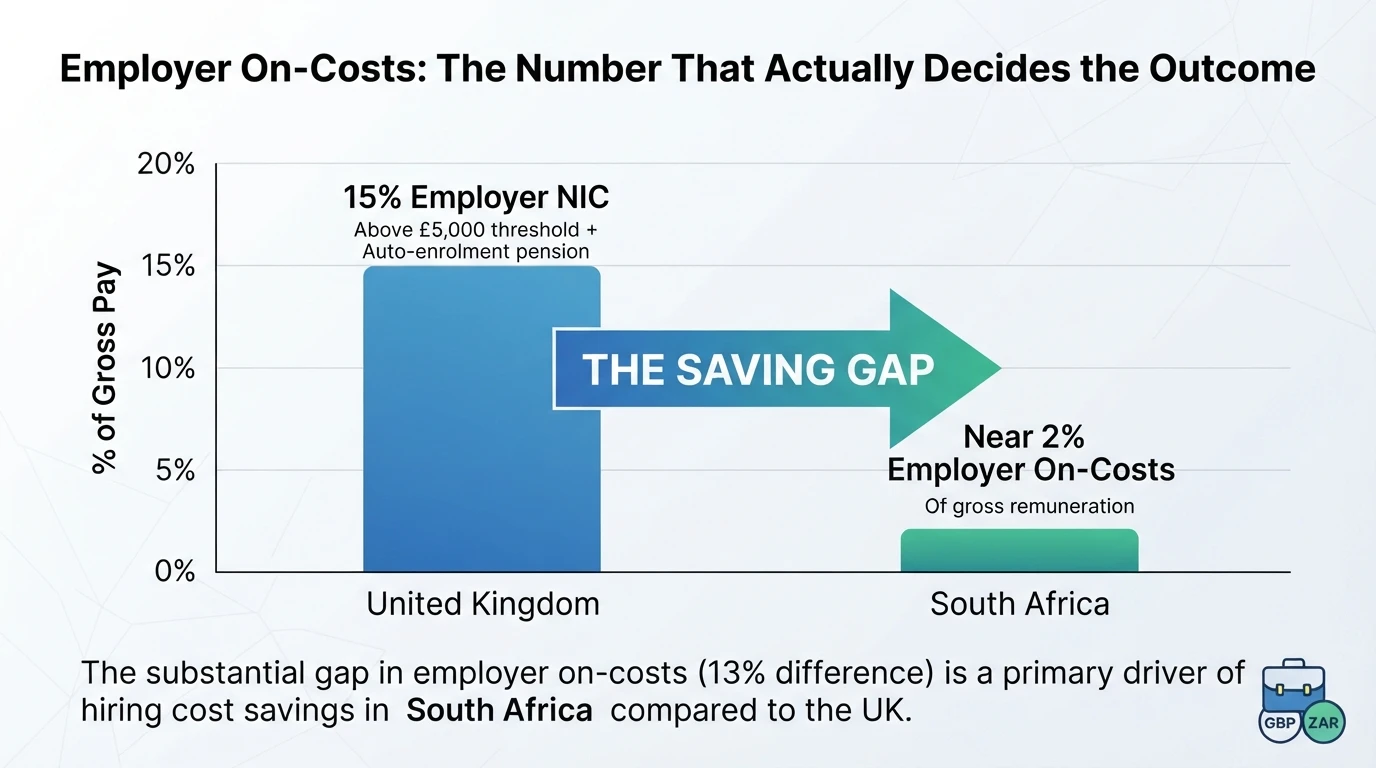
Salary is only the start. Employer on-costs, the statutory contributions you pay on top of gross pay, decide whether a hire saves you money. In the UK that load sits at 15% employer National Insurance above a £5,000 secondary threshold, plus auto-enrolment pension. In South Africa it is roughly 2% of gross remuneration. That gap, not the salary itself, is where most of the saving lives.
Why the UK load has risen and the South African load has not
The UK rate climbed from 13.8% to 15% in April 2025, while the secondary threshold fell from £9,100 to £5,000. Both remain in place for 2026/27. The result: from £5,000 of salary onwards, every pound costs you 15% more than the wage itself. South Africa’s employer contributions have stayed near 2%, so the gap has widened rather than narrowed.
What an Employment Allowance does and does not offset
Eligible employers can claim up to £10,500 against their NI bill for 2026/27, which helps at company level. But it offsets the bill, not the per-hire economics. It covers a handful of hires, then the full 15% applies to every additional role.
Capping UIF and knowing which contributions actually apply to your worker
South Africa’s Unemployment Insurance Fund contribution is 1% from the employer, capped at a set monthly earnings ceiling, and Skills Development Levy applies only above an annual payroll threshold. Which contributions apply depends on how you employ: an employer of record carries them for you, and the EOR cost breakdown shows how this fits the total.
Role-by-Role Cost Comparison for UK Business Functions
The same job title carries a very different price tag depending on where the person sits. Below, we run three common functions through the calculator model, using UK salary bands with 15% employer NIC and South African rand salaries with roughly 2% employer on-costs. Salary bands shift with seniority, so treat these as mid-market figures for 2026.
Virtual assistants, executive support and admin
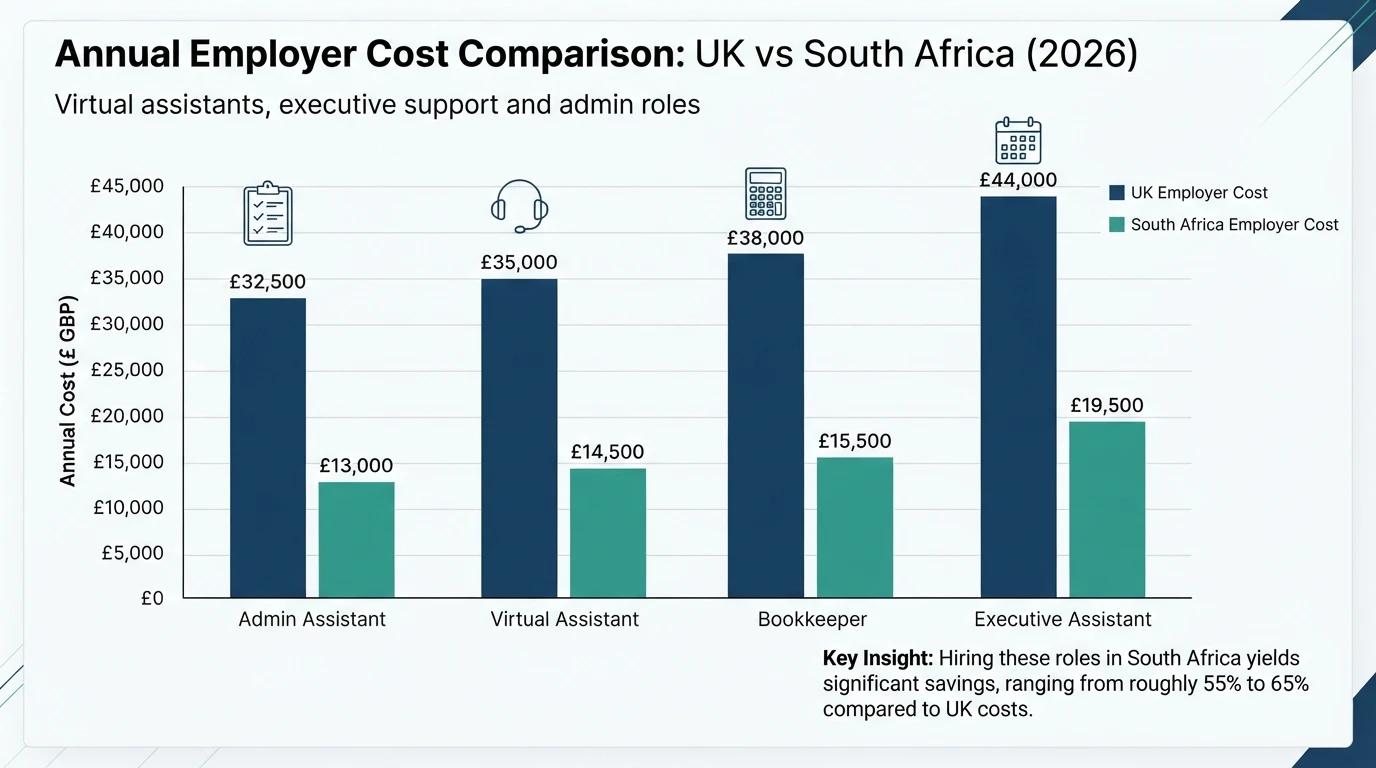
A UK admin assistant or VA at £24,000 gross costs an employer near £28,000 once NIC and pension land. In South Africa, average VA pay sits around R8,700 per month according to Indeed’s salary data, which is roughly £19,000 a year at current rates, and on-costs add little. Executive assistants with strong diary and inbox skills command more, but the saving still lands between 55% and 65%. If you want the full salary bands by role, the team has published a South Africa salary guide for UK businesses.
Customer support and contact centre teams
This is where the calculator gap shows most clearly. Earlier in this guide, a £52,000 UK support budget in Manchester turned into roughly £60,000 of employer cost. The same tier-one role run from Johannesburg lands between £17,000 and £22,000 all in, with GMT+2 covering the UK working day. Team leads cost more on both sides, so the ratio holds as you scale. Full in-hours overlap also stays realistic because South Africa sits only two hours ahead.
Bookkeeping, finance admin and month-end close
A UK bookkeeper at £30,000 becomes roughly £35,500 with employer charges. A South African bookkeeper with Xero or Sage experience typically costs £12,000 to £18,000 all in, with 2% on-costs. Month-end close, reconciliations and VAT prep run well across the timezone gap, and finance work suits structured handovers. The key check is cloud software access and data rules, which you set out before the first close, not after.
Building Your Own South African Employment Cost Calculator
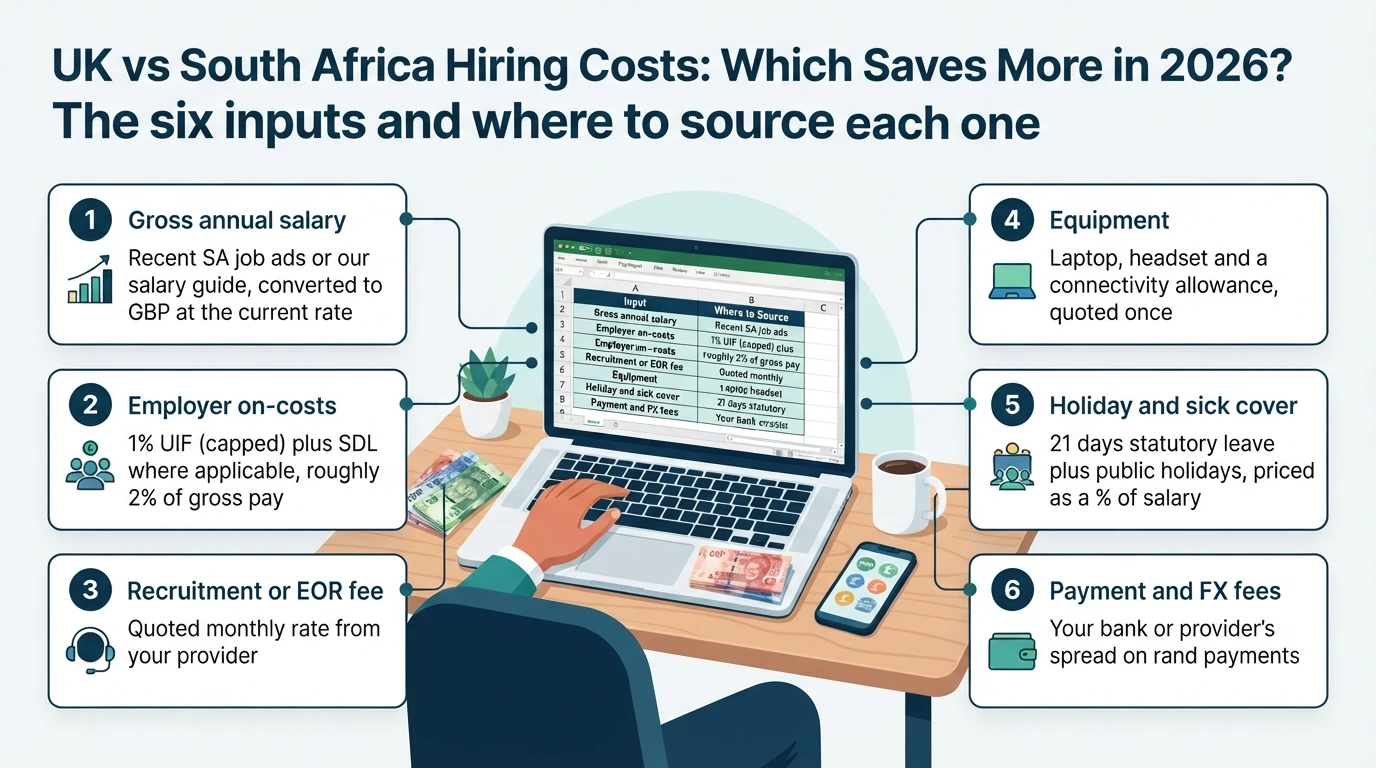
A spreadsheet with six inputs gives you a per-role total cost in under ten minutes. If you want a worked version to start from, our total hiring cost comparison uses the same method.
The six inputs and where to source each one
| Input | Where to source it |
|---|---|
| Gross annual salary | Recent SA job ads or our salary guide, converted to GBP at the current rate |
| Employer on-costs | 1% UIF (capped) plus SDL where applicable, roughly 2% of gross pay |
| Recruitment or EOR fee | Quoted monthly rate from your provider |
| Equipment | Laptop, headset and a connectivity allowance, quoted once |
| Holiday and sick cover | 21 days statutory leave plus public holidays, priced as a % of salary |
| Payment and FX fees | Your bank or provider’s spread on rand payments |
Worked example and sensitivity testing
Take a £18,000 customer support hire. Add 2% on-costs (£360), a £250 monthly provider fee (£3,000 a year), £600 of kit and 5% for leave cover (£900). The all-in figure lands near £22,900. Then test the edges: swap in a £21,000 candidate, raise the rand by 10%, or double the FX fee. If the saving survives the worst case, the hire is safe to approve.
Costs to leave out of the model and why
Skip training time, management hours and software licences in the first pass. They apply to any hire, UK or South African, so they cancel out in the comparison. Include them only when a South African hire would need extra overlap hours or a specific tool a UK hire would not. Mixing shared costs into one side is what makes savings claims fall apart.
Employer of Record, Own Entity, Contractor or Full Outsourcing
Four routes can put a South African on your payroll, and the compliance weight differs sharply. Contractors suit short trials. An employer of record (EOR) handles PAYE, UIF and contracts for you. A local entity gives full control at the highest cost, and managed outsourcing hands over delivery as well as employment.
Route one and two: contractors and employer of record
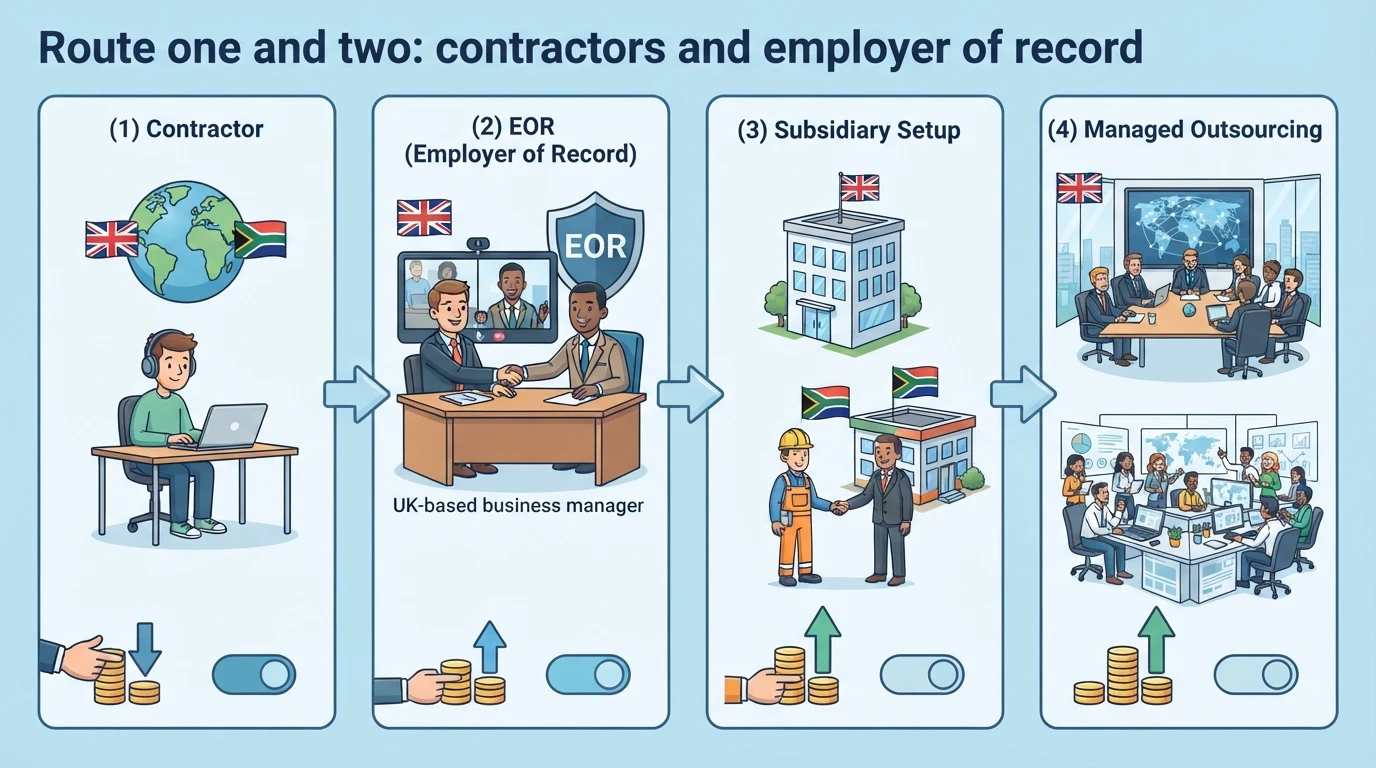
Hiring someone as a contractor looks cheap, but South Africa’s Revenue Service and the UK’s IR35 rules both test whether the person is really an employee. Get it wrong and you owe back taxes and penalties. An EOR removes that risk: it employs the person locally, runs payroll in rand and bills you one monthly fee.
Route three and four: local entity and managed outsourcing
Registering a South African subsidiary makes sense once you employ ten or more people there, because setup, directors, audits and VAT registration run to five figures a year. Managed outsourcing goes further, adding supervision and quality checks, which suits teams you cannot manage directly.
Where breakeven actually sits
An EOR route in South Africa stays cheapest until headcount or management need forces the change. Under roughly five hires, EOR fees cost less than running an entity. Past that, compare entity overhead against EOR fees annually and switch only when the maths clearly favours it.
The Hidden Costs That Eat the Savings
A £17,000 South African hire can quietly become £25,000 if you ignore the extras. None of these are dealbreakers, but they belong in your sums.
Equipment, power and connectivity resilience
Every remote hire needs a laptop, headset and software licences. Budget £600 to £1,200 upfront, or fold kit into the monthly fee. South Africa’s load shedding (planned power cuts) has eased, but outages still happen, so serious candidates run a UPS or inverter and a mobile data backup. Ask about it at interview and pay for a decent setup. Teams using Hire SA Talent usually check internet and power continuity before day one, so the hire is not offline when you need them.
Management overhead and time zone friction
GMT+2 gives you most of the UK day, but a two-hour gap still costs something. A manager spending five hours a week on check-ins, handovers and rework adds roughly £3,000 a year at a £40,000 salary. Good documentation and clear ownership shrink that fast; a structured approach to managing a South African remote team covers most of it.
Leave calendars, attrition and currency movement
South African leave runs on a different calendar, with December shutting down for weeks. Plan cover or accept slower response. Expect some attrition, so keep a recruitment reserve. And the rand moves: a weak pound raises your cost in sterling terms, so review rates twice a year.
What Changes in 2026 and What to Watch
The UK side: 2026/27 in practice
Nothing moves in your favour. The 15% employer NIC rate and the £5,000 secondary threshold both carry into 2026/27, and the National Minimum Wage rise lands again in April. The Employment Rights Bill also phases in from April 2026, including day-one rights for new staff, which adds cost and process risk to any UK hire. Plan around the current rates, not lower ones.
The South African side: stability, salary pressure and currency
South Africa’s statutory load stays near 2% of gross pay, with UIF capped and SDL applying only above the threshold. The pressure comes from salaries and the rand: experienced staff expect raises, and a stronger rand slowly erodes the discount. Budget for annual salary uplifts and review the exchange rate quarterly rather than assuming the current rate holds.
When the gap narrows
The saving shrinks if you need deep on-site presence, regulated UK-only roles, or roles where senior UK salaries sit close to SA equivalents. For remote operational work, the maths still favours Johannesburg.
Which Should You Choose: UK or South Africa?
The right answer depends on how the work gets done, not just what it costs. UK hiring wins on hands-on roles that need a physical presence. South Africa wins on remote operational roles where the same skills cost a fraction of the price.
When UK hiring is still the right answer
Hire locally when the job cannot be done well over a screen. Warehouse, facilities, field sales and client-facing roles need someone in the region. You may also prefer UK staff for work under tight regulatory oversight, or where you need same-city cover for shift and holiday rotas. And if the role is genuinely junior, the salary gap narrows once you add management time on both sides.
When South Africa is clearly the better answer
South Africa wins for remote operational roles: customer support, VA and admin work, bookkeeping, sales support, marketing execution and IT helpdesk. GMT+2 keeps most of the UK working day covered, English is the working language, and employer on-costs stay near 2% instead of 15%. A support role that costs around £60,000 all in from Manchester lands between £17,000 and £22,000 from Johannesburg, with no drop in service quality.
How to move from decision to first hire
Start with one role, not a whole team. Score the candidate on the same basis you would a UK hire, and set hours, tools and reporting lines in writing before the offer. An introduction-to-employment partner then handles the South African side, and you can browse the roles UK businesses most often fill here as your first shortlist.

Your calculator shows where the money goes; we show you how to capture it. Hire SA Talent connects UK firms with vetted South African support, finance, sales, marketing and IT staff through a compliant hiring route. Send us one role and we’ll map its full cost, both countries.
Frequently Asked Questions
Q1: What is the cheapest compliant hiring route?
An employer of record. It stays cheapest under roughly five hires because one monthly fee beats entity overhead, and it removes contractor misclassification risk under IR35 and SA law. Registering a subsidiary only pays off at ten or more staff.
Q2: How much can I really save per hire?
For remote operational roles, typically 55% to 65%. A support role costing about £60,000 all in from Manchester lands between £17,000 and £22,000 from Johannesburg.
Q3: Do I need a South African entity to hire there?
No. An EOR employs staff locally and runs PAYE, UIF and contracts in rand for you. An entity makes sense only at scale, once you employ around ten people.
Q4: Are there legal risks hiring South African staff as contractors?
Yes. Both SARS and IR35 test whether someone is really an employee. Get it wrong and you owe back taxes and penalties.
Q5: What hidden costs should I budget for?
Equipment (£600 to £1,200), connectivity backup, management check-in time, December leave cover and rand exchange movement. Build all four into your model.
Q6: Does the timezone gap hurt productivity?
A two-hour offset still covers most of the UK working day. Clear handovers and documentation keep the friction small.
Conclusion
The numbers decide it. UK employer costs stack 15% NIC and pension onto every salary, while South Africa’s statutory load stays near 2%, so a role costing £60,000 all in from Manchester lands between £17,000 and £22,000 from Johannesburg. Build your comparison per role with the six-input calculator, budget for kit, management time and rand movement, and use an employer of record until you pass roughly five hires. For remote operational work, the saving survives the worst case. Keep UK hiring for roles that need physical presence or same-hours cover.