Quick Summary: UK employers can reduce fully loaded staffing costs by 55% to 70% by hiring remote professionals in South Africa. South African statutory employer levies average just 2% to 4%, compared to UK employer National Insurance at 15% plus mandatory pensions. Partnering with a dedicated staffing service like Hire SA Talent lets UK businesses source skilled, English-speaking talent while removing local compliance and payroll burdens.
For UK firms squeezed by domestic margin pressure, South Africa offers equivalent professional skill with fully loaded employment savings of 55% to 70%. The gap comes from two sources: favourable exchange rates and statutory employer charges of roughly 2.8% in South Africa against over 15% in the UK. Hiring managers now face rising wages, agency fees and higher Employer National Insurance, so finance leaders are re-examining where their teams sit. This analysis acts as a practical south africa salary guide for UK employers, comparing gross pay bands, mandatory levies, benefits and overhead. Treated as a working south africa salary guide for UK employers, it gives finance and HR directors the numbers to model both routes, and this south africa salary guide for UK employers covers support, finance, sales, marketing and IT roles.
UK vs South Africa Employment Cost Parameters: Structural Comparison
| United Kingdom Direct Domestic Employment | South Africa Remote Professional Staffing | |
|---|---|---|
| Average Annual Base Salary (Mid-Level Operations) | £32,000 – £42,000 per annum | £10,000 – £16,000 equivalent (ZAR 240,000 – ZAR 385,000) |
| Mandatory Employer Payroll Taxes & Levies | 15.0% Employer Class 1 NICs on earnings above £5,000 threshold | 2.25% – 2.80% total (1% UIF capped at R177.12/mo, 1% SDL, 0.25%-0.8% COIDA) |
| Mandatory Pension & Retirement Contributions | 3.0% minimum statutory employer auto-enrolment on qualifying earnings (£6,240-£50,270) | 0% statutory mandate (market-driven voluntary group provident schemes: 5%-7.5%) |
| Statutory Paid Leave Entitlements | 28 days paid statutory annual leave (including 8 bank holidays) | 21 consecutive days (15 working days) annual leave + 12 South African public holidays |
| Average Fully Loaded On-Cost Premium Above Base | 18% to 25% statutory and administrative burden (excluding workspace and hardware) | 4% to 12% (statutory levies plus optional competitive medical aid/provident subsidy) |
| Procurement & Compliance Framework Options | Direct domestic PAYE contract, UK payroll administration, and standard HMRC compliance | Embedded staffing partner (such as Hire SA Talent introducing via SA Konexion), compliant EOR, or local subsidiary entity |
How United Kingdom Direct Domestic Employment and South Africa Remote Professional Staffing Compare
United Kingdom Direct Domestic Employment
This is the traditional route: hire directly onto UK PAYE payroll with full HMRC compliance. It suits firms that need on-site presence, but wages, 15% employer National Insurance and auto-enrolment pensions push up the total bill.
Key strengths
- Domestic payroll and HMRC compliance in one framework
- 28 days statutory paid leave including bank holidays
South Africa Remote Professional Staffing
This route hires skilled South African professionals remotely through a compliant staffing partner or EOR. It suits UK firms wanting embedded support roles at lower cost, with GMT+2 hours that overlap the UK working day.
Key strengths
- Statutory employer levies of just 2.25% to 2.80%
- Base salaries from £10,000 to £16,000 equivalent
- Fully loaded on-costs typically 4% to 12%
Macroeconomic Fundamentals: Currency Valuation and Purchasing Power Parity
Purchasing Power Parity and Talent Retention Dynamics
Currency moves are the first lever behind the 50% to 70% cost gap. The pound trades at roughly R21.90, and one rand buys about £0.05, according to Wise’s live converter. So a salary you budget in pounds stretches far further when your provider pays staff in rands.
But the exchange rate alone is not the story. Purchasing power parity (PPP) measures what money actually buys in each country. Rent, food, transport and childcare in Johannesburg or Cape Town cost a fraction of London prices, so a South African professional paid well under UK rates still enjoys a strong local standard of living. That is what makes the saving sustainable rather than exploitative.
It also protects retention. If a salary feels fair locally, staff stay, and you avoid the churn that plagues cheap offshore markets. Rand softness helps, but fair local pay keeps people.
The risk cuts both ways. A weaker rand boosts your savings; a stronger rand shrinks them. Most UK employers set contracts in rands, so salaries hold value locally while your budget absorbs modest currency swings.
Plan around the lower range of your forecast, not the best rate. For current salary levels, see our South Africa salary guide.
Direct Salary Benchmarks Across Core Operational Functions
Salaries vary more by role than by country. The table below shows typical monthly base pay for the roles UK firms hire most often in South Africa.
| Role | Typical Monthly Salary (ZAR) | Approx. GBP Equivalent |
|---|---|---|
| Virtual Assistant | R15,000 to R35,000 | £650 to £1,500 |
| Customer Support Agent | R12,000 to R18,000 | £520 to £780 |
| Bookkeeper | R15,700 to R25,000 | £680 to £1,080 |
| Sales Executive | R18,000 (R218,000 a year) | £780 |
| Digital Marketing Manager | R20,000 (R240,000 a year) | £870 |
| Software Developer | R41,000 (R495,000 a year) | £1,800 |
Administrative, Finance, and Operational Support Compensation Bands
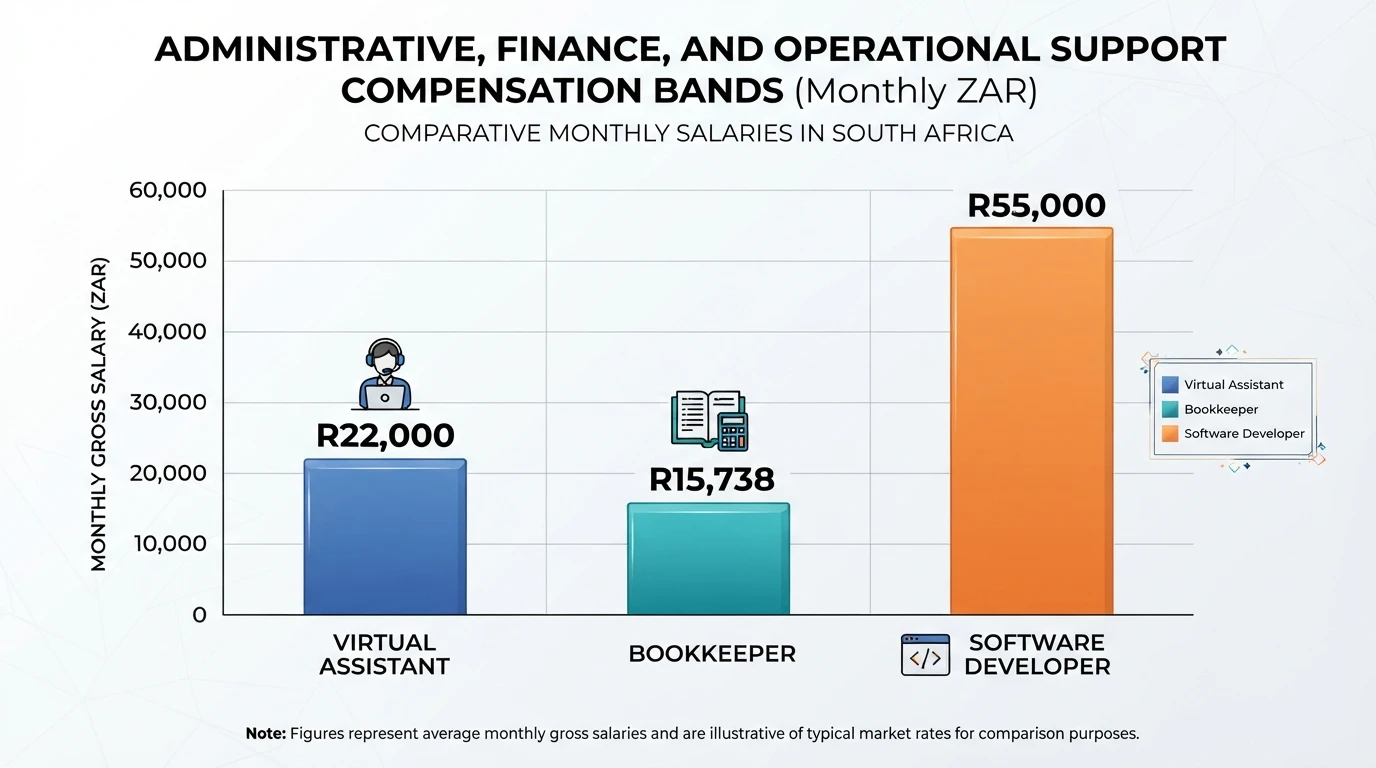
Back-office roles sit at the lower end of the pay scale. Virtual assistants earn about R7,446 per month on average, though experienced UK-facing assistants command R15,000 or more, according to Indeed salary data. Customer support agents average around R126,595 a year, or roughly R10,500 a month.
Bookkeepers earn more because the work carries compliance risk. The average sits at R15,738 per month, based on over 1,000 reported salaries on Indeed. PayScale puts the annual figure at R218,911, with a range from R103,000 to R361,000 depending on experience.
Commercial, Marketing, and Technical Engineering Remuneration
Revenue and technical roles cost more, but still far less than UK equivalents. Sales executives average R218,036 a year. Digital marketing managers earn about R240,000 annually, while copywriters sit near R300,000, per Talent.com’s 2026 salary data.
Software developers earn the most. Indeed reports an average of R495,823 a year, around R41,300 monthly. Even at this level, a UK firm pays roughly a third of a London developer’s salary. These bands are guides, so treat final offers as ranges shaped by experience, English fluency, and overlap with UK hours.
Hiring staff means paying tax on top of salary in both countries. The question is how much.
United Kingdom Employer National Insurance and Pension Obligations
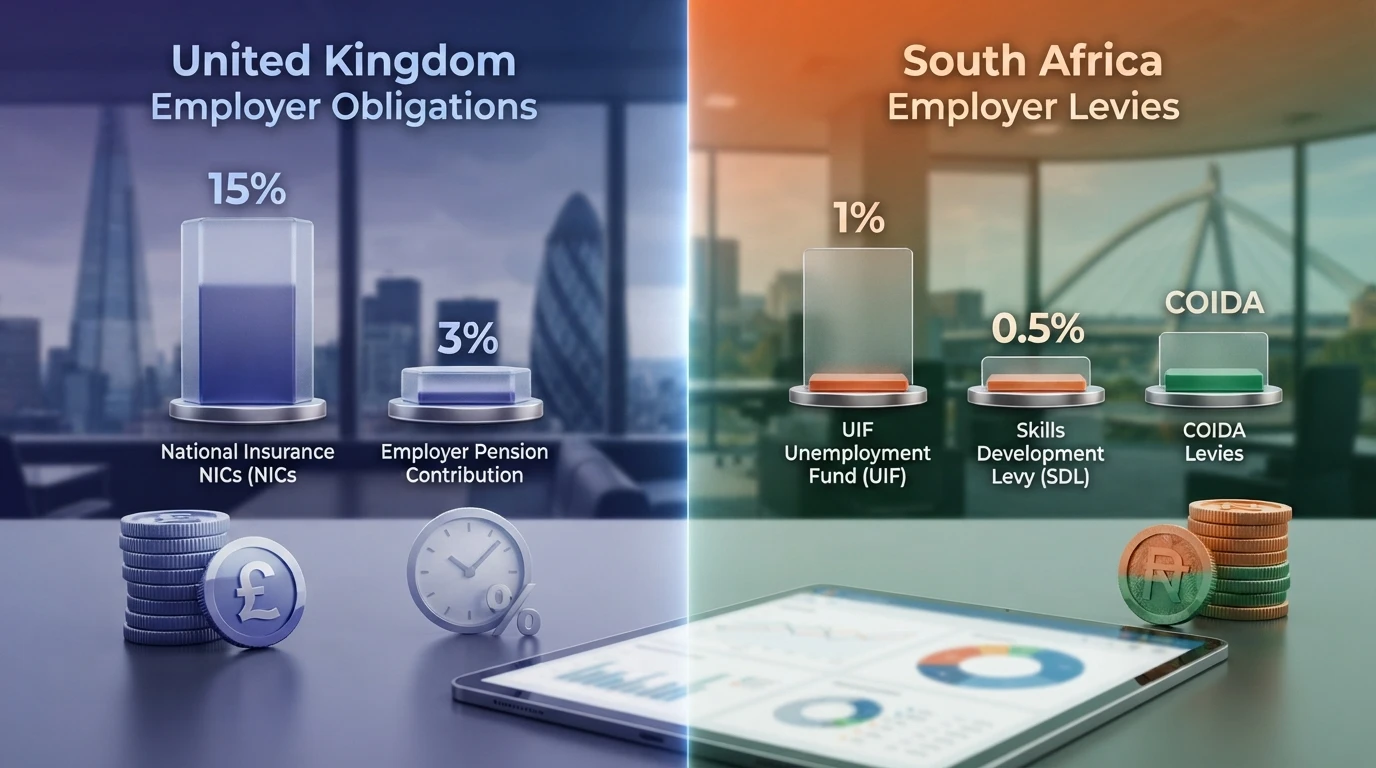
UK employers pay Class 1 employer National Insurance (NICs) at 15% on earnings above a £5,000 annual secondary threshold, a rate and threshold both tightened from April 2025. On a £30,000 salary, that alone is roughly £3,750 a year. The Employment Allowance can offset up to £10,500 for smaller employers, per GOV.UK guidance.
On top sits auto-enrolment pension duty: 3% minimum employer contribution on qualifying earnings between £6,240 and £50,270, about £700 a year at that same salary. Add apprenticeship levy exposure and the true on-cost approaches 18% of salary.
South African Mandatory Payroll Levies: UIF, SDL, and COIDA
South African employers face a lighter stack. Unemployment Insurance Fund (UIF) contributions cost 1% of pay, matched by a 1% employee deduction. The Skills Development Levy (SDL) adds 0.5%, though it only applies once monthly payroll exceeds R500,000. COIDA, the workers’ compensation cover, is a small assessment that varies by sector, typically well under 2%.
Together these usually total 2% to 4% of salary, a fraction of the UK load. You can see how each levy works in practice in our South African payroll guide for UK employers. The saving is structural, not promotional.
Customary Benefits, Leave Entitlements, and Discretionary Overhead
South African employers pay more than statutory charges. Two market customs dominate: private medical aid contributions and the so-called 13th cheque. Neither is required by law, but both are common for skilled white-collar staff, so budget for them from day one.
Market-Standard Benefits: Medical Aid and the 13th Cheque
Most South African professionals expect employer help with medical aid contributions, typically 50% of the premium. A basic plan costs roughly R1,500 to R2,500 per employee per month. Some employers also pay a 13th cheque, an extra month’s salary paid in December, though annual bonus structures vary by company. In UK terms, this is similar to private health cover plus a bonus, so the cost difference stays proportionate to salaries. The rule of thumb: build about 10-15% extra on top of gross pay for benefits, and your fully loaded model stays honest. For worked examples, see the full South Africa vs UK cost comparison.

Statutory Paid Leave and Operational Coverage
Leave rules mirror the UK closely. Employees earn 15 days of annual leave per cycle, plus about 12 public holidays. Sick leave runs one day per 26 days worked, roughly 15 days over three years. Maternity leave is four months, with the fund paying a portion of wages. Factor cover arrangements into your rota so holiday gaps don’t slow support, finance, or admin work.
Hidden Overhead: Equipment, Infrastructure, and Operational Risk Mitigation
Salary is only part of the real cost. The gear, connection, and backup plans behind each hire quietly shape your budget on both sides of the comparison.
Physical Office Overhead vs Distributed Remote Technology Provisioning
A UK desk in a serviced office can run £400 to £800 a month once you add rent, rates, internet, and utilities. Remote South African staff swap that fixed cost for a one-off kit: a laptop, headset, and a modest home-office stipend. Most providers budget £300 to £600 per hire upfront, then under £50 a month. Well-run setups also mean a UK firm can embed staff without leases. Practical guidance on running distributed teams is covered in our remote team management guide.

Power Redundancy and High-Bandwidth Telecommunications Resilience
Load shedding, South Africa’s scheduled power cuts, is the risk most UK employers ask about first. Serious candidates answer it with a UPS or inverter, a backup power source, and a fibre line paired with LTE as failover. Build a stipend of £20 to £40 a month into your model. Screen for these setups at interview stage, because an outage-prone hire costs more than any kit.
Compliance, Legal Exposure, and Engagement Architectures
The legal risk of hiring in South Africa depends less on the rules themselves than on who employs the person. Structure the engagement correctly and South African labour law never reaches you as the employer of record.
Labour Protection Frameworks: UK Employment Tribunals vs CCMA Mandates
Both countries protect employees strongly, but the mechanics differ. UK claims go through employment tribunals, where compensation for unfair dismissal is capped at a year’s pay and claims can take a year or more to reach a hearing. South Africa routes most disputes to the CCMA, which resolves the average case in around two months, with dismissal compensation capped at 12 months’ salary. The real risk is procedural: employers must prove both a fair reason and a fair process before any dismissal, or face reinstatement orders.
Tip: Keep written disciplinary records in both jurisdictions. In South Africa, missing documentation is the most common reason employers lose CCMA arbitrations.
Engagement Models: Direct Subsidiary, EOR Providers, and Dedicated Staffing Partners
Three routes exist. Setting up a South African subsidiary gives full control but brings registration costs, payroll compliance, and audit obligations that rarely suit a first hire. An EOR provider such as Deel or Oyster becomes the legal employer, handling contracts, PAYE, and UIF on your behalf. Dedicated staffing partners like Hire SA Talent go further: they recruit, employ, and manage the staff locally, so dismissal risk, benefits, and statutory on-costs stay with the local employer rather than your UK entity. For SMEs hiring one to ten remote staff, that model removes the compliance workload entirely.
Comprehensive Total Cost of Employment (TCOE) Case Scenarios
Abstract rates only go so far. These two scenarios show how salary, statutory on-costs and UK equivalents stack up in practice, using a base salary plus the main South African employer charges: UIF at 1%, SDL at 1% (when registered) and COIDA cover.
Scenario A: Solo Operational Hire (Full-Time Bookkeeper / Junior Accountant)
Take a junior bookkeeper on R15,000 per month, close to the national average of about R15,738 reported on Indeed. Add the employer’s statutory charges:
| Cost Item | Monthly (ZAR) |
|---|---|
| Base salary | R15,000 |
| UIF (1%) | R150 |
| SDL (1%) | R150 |
| COIDA estimate | R75 |
| Fully loaded | R15,375 |
That is roughly £680 at typical exchange rates. A UK bookkeeper at £28,000 costs the employer about £32,200 once 15% employer NICs and pension contributions apply. The saving sits near 75%, before you count the EOR fee, which usually adds £150 to £300 monthly. Even fully loaded, you keep more than half the UK cost.
Scenario B: Multi-Seat Operational Expansion (Team of Four: VA, CS Lead, and Two SDRs)
Now scale to four seats: a virtual assistant at R14,000, a customer support lead at R25,000, and two sales development reps at R20,000 each. Salaries total R79,000, or about £3,450 monthly. On-costs of roughly 2% to 3% add under R2,400, so the fully loaded bill stays near £3,500.
The UK version of the same team costs about £14,500 in employer charges once NICs and pensions land on top of gross salaries. Across a year, that gap is roughly £132,000, enough to fund an extra five hires, better tooling or a bigger marketing budget. Scale also cuts your EOR fee per head, since most providers discount multi-seat teams.
Tip: Model both scenarios with your own salary assumptions. Small rate changes in the ZAR/GBP exchange shift savings more than any on-cost line does.
Strategic Decision Matrix: Determining the Optimal Hiring Route for Your Business
When Domestic UK Onshore Hiring Remains Essential
Some roles simply need to sit in the UK. Jobs that require face-to-face client meetings, physical presence, or UK-regulated qualifications (such as certain audit, legal or financial advice work) belong onshore. The same goes for roles where security policy or client contracts demand UK-based staff. In these cases, the 15% employer National Insurance cost and pension duties are part of the price of doing business, not a problem to engineer away.
When Building a South African Workforce Delivers Maximum Enterprise Value
If the work is digital, process-driven and managed through clear outputs, a South African team wins on almost every measure. Fully loaded costs drop by 50% to 70%, time zones overlap almost entirely with UK hours, and English fluency is high. This applies across virtual assistants, customer support, bookkeeping, sales support, marketing and IT. The savings compound: at £40,000 UK on-costs versus roughly £15,000 in South Africa, each hire funds the next one. Our guide to outsourcing to South Africa walks through the setup step by step, and Hire SA Talent connects you with vetted candidates for each function.
Those savings only become real when the hiring is done right. Hire SA Talent connects UK firms with reliable South African staff across support, finance, sales, marketing and IT. Start with a no-obligation chat at Hire SA Talent.
Frequently Asked Questions Regarding UK and South African Hiring Costs
Q1: What are the salary and employer costs of hiring in South Africa?
White-collar salaries typically run 50-70% below UK equivalents, and employer charges stay light: UIF, SDL and COIDA, versus the UK’s 15% NICs plus pensions.
Q2: Are South African staff employees of my UK company?
No. An employer of record legally employs them locally. Hire SA Talent introduces clients; SA Konexion handles recruitment and employment compliance.
Q3: What statutory employer on-costs apply in South Africa?
UIF contributions, a skills development levy and COIDA insurance, generally totalling far less than UK employer National Insurance.
Q4: How do time zones work for UK teams?
South Africa shares UK working hours year-round, so support, sales and finance staff overlap fully.
Q5: Can I hire part-time or role-specific staff?
Yes, full-time and part-time routes exist across support, admin, finance, marketing, IT and executive support roles.
Conclusion
The numbers settle the argument. A South African hire costs 50% to 70% less once you compare fully loaded figures: UK Employer NICs at 15%, auto-enrolment pensions and higher base salaries versus UIF, SDL and COIDA charges. Roles from customer support to IT deliver similar quality at a fraction of the UK rate. Your real decision is less about salary than about structure. Compare salary benchmarks for the roles you need, then choose a compliant hiring route that handles contracts, tax and payroll on your behalf.