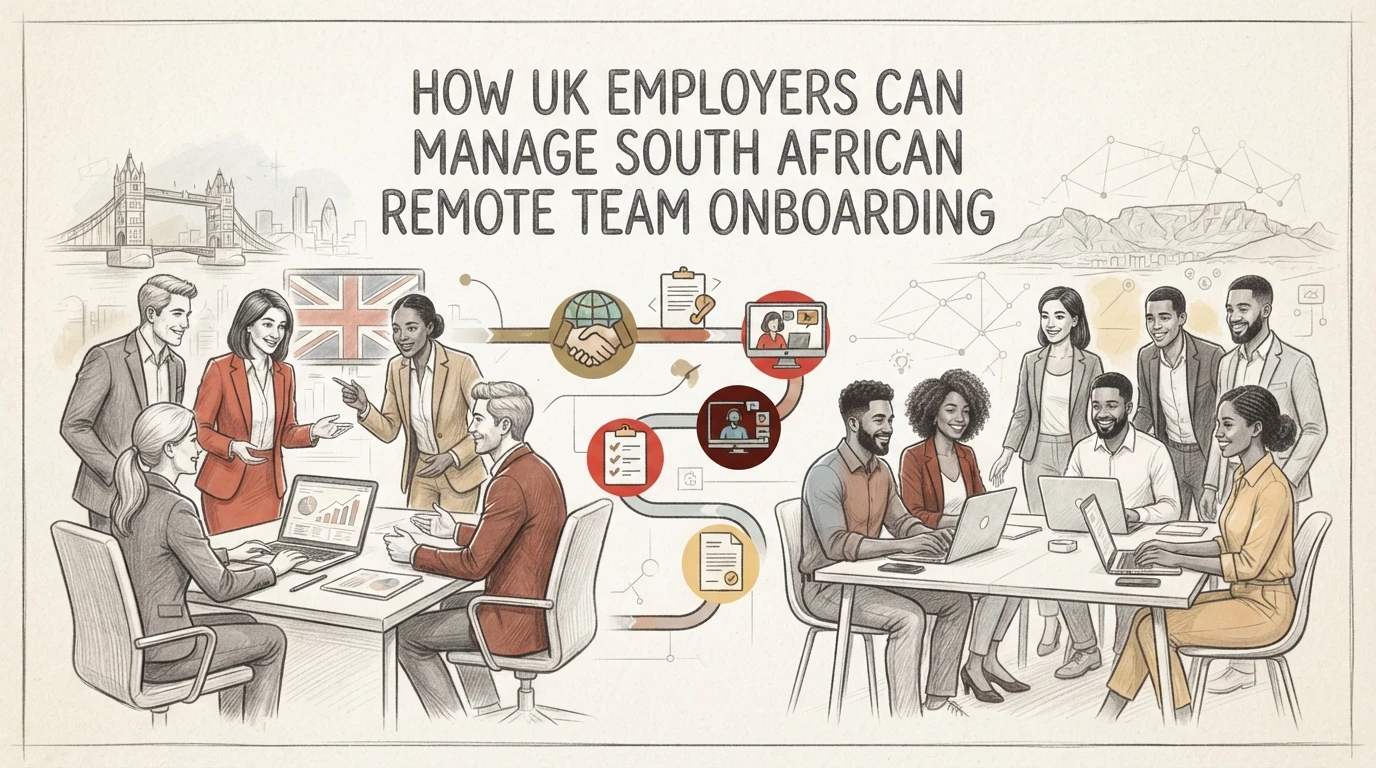
Quick Summary: UK managers onboarding their first remote South African hire should split ownership cleanly: SA Konexion handles contracts, rand payroll, and statutory compliance through the employer-of-record layer, while the UK manager owns the welcome, tools, goals, and reviews. Before day one, sort a pre-boarding week with a personalised welcome, tested VPN, and a load shedding fallback, then agree core UK-SA overlap hours and need-to-know data access under POPIA. Run a 30-60-90 cadence to lock in foundations, hand over real ownership, and make an explicit fit call. Hire SA Talent recruits the candidate and hands them to SA Konexion for employment, giving you one page, two owners, and zero gaps.
Your UK firm has just offered a Cape Town-based customer support lead the job. Her contract is signed through an employer of record, her laptop is in transit, and her first shift starts on Monday. The next ten days decide whether she is productive in week two or quietly job-hunting by month four.
Most UK hiring managers have never run a cross-border start. A remote employee onboarding checklist built for British hires misses the South African specifics: load shedding backup plans, UK overlap hours, POPIA-aware data access and rand payroll through the EOR. This guide gives you a remote employee onboarding checklist for each phase, split into a 30-60-90 cadence, with every step assigned to you or the SA Konexion employment team so ownership is never in doubt. Treat this as the remote employee onboarding checklist your first South African hire deserves.
Step 1: Run a Pre-Boarding Week That Closes the Trust Gap
The week before day one decides whether your new hire feels expected or forgotten. Use it to finish the legal setup, send something personal, and get tools working before the laptop opens.
Hand Contracts and Statutory Setup to the EOR
Your EOR is the legal employer in South Africa, so it owns the contract, payroll registration and statutory deductions under South African law. Send it the salary, role and start date as soon as the offer is accepted, and ask for the signed SA-compliant contract to be issued within two working days. Confirm the employee is registered for payroll, including tax and contributions, before day one, because a late first salary damages trust faster than anything else. Hire SA Talent introduces clients and coordinates with the SA Konexion employment team, who handle this employment layer for you. Ask one named contact to confirm each item in writing, so you always know who owns what.
Send a Personalised Welcome and a “First Week at a Glance” Doc

A template welcome email reads like one. Instead, send a short note from the hiring manager naming one project the new hire will touch in week one, plus a one-page “First Week at a Glance” doc. List day-by-day meetings, the buddy’s name, login details they will receive, and your shared working hours, since South Africa runs one to two hours ahead of the UK. Ten minutes of your time, and it removes the biggest day-one fear: “will anyone actually talk to me?”
Pre-Provision Hardware, VPN and POPIA-Scoped Data Access
Ship the laptop early and test the VPN login before the start date. Then set access limits: under POPIA, South Africa’s data privacy law, personal information must only be processed for a specific purpose, so grant the minimum systems and data the role needs on day one, nothing more. A POPIA overview shows how the rules work like GDPR, which most UK managers already know.
Step 2: Nail the First Day and First Week
Day one sets the tone. A new hire in Cape Town or Johannesburg cannot walk over and ask a quick question, so your job is to remove every reason they would need to. Plan the first day and first week with the same care you gave pre-boarding, and ownership stays clear: you run the work side, and SA Konexion handles the employment side.

Day One Agenda: Introductions, Tools and a Quiet First Win
Keep it short and human. Open with a 30-minute video welcome: one manager, the immediate team, and a round of names and roles. People remember faces better than org charts.
Next, confirm tools work. Log in together to Slack or Teams, email, the project tracker and any shared drives. Test the headset and screen share while you are on the call, not after.
Then give one small, low-risk task, such as reviewing a document or updating a checklist. A quiet first win builds confidence and gives you something real to give feedback on by the end of the day.
Week One Schedule: Shadow, Ship and Socialise
Structure the week around three verbs. Shadow: pair the new starter with a UK colleague for two or three sessions so they hear how decisions actually get made. Ship: assign two or three real deliverables with clear deadlines, one per day by Friday. Socialise: book one informal 20-minute coffee chat, no agenda, so the relationship is not purely transactional.
Close the week with a 30-minute review. Ask what was unclear, what surprised them and what they need next week. Write down the answers; they become your week two plan.
Set the UK-SA Working Hours and Comms Norms
South Africa runs on the same clock as the UK, so overlap is easy, but load shedding and school runs still shift personal rhythms. Agree core hours, response-time expectations for chat versus email, and who to ping first. The guide to UK and South Africa working hours covers typical overlap patterns in detail.
Step 3: Lock Down South Africa-Specific Risks in Week One
South African remote work runs on its own clock, grid and calendar. Handle three risks before the end of week one: power cuts, public holidays and data rules.
Build a Power and Connectivity Continuity Plan
Load shedding has eased sharply. South Africa passed 300 days without power cuts by early 2026, and Eskom’s summer outlook projected no load shedding through March. But the risk has not disappeared, so plan for it anyway.
Ask your new hire what backup they have. An inverter, UPS, charged laptop and mobile data tether cover most short outages. Agree on a simple rule: if power or internet drops for more than 30 minutes, they message you on their phone and switch to offline tasks. Load this into the checklist you set in Step 2.

Mark SA Public Holidays and Local Leave Rules on the Calendar
South Africa has about 12 public holidays a year, and they differ from the UK list. Human Rights Day in March and Heritage Day in September will surprise you if they are not on your team calendar. Add every SA holiday to the shared calendar now, and ask which days off your employee plans to take around them. SA Konexion handles statutory leave under the employment contract, so your job is scheduling around it, not calculating it.
Scope Data Access to Stay POPIA-Compliant
POPIA, South Africa’s data protection law, governs how your employee handles personal data. Grant access on day one, but only to what the role needs: no shared logins, no blanket CRM exports. Then have them sign a short data handling note covering storage and deletion. The SA Konexion employment team can confirm the local requirements, and your own UK-SA data access steps cover the UK side.
Step 4: Run a Structured 30-60-90 Day Plan
The first three months decide whether a South African hire becomes a trusted colleague or a slow fading line on your org chart. Give each phase one job: confirm the basics, hand over real ownership, then make a clear call on fit.
Day 30: Confirm Foundations, Tools and Trust
By day 30, check the setup works in both directions. Has the time overlap held? Did load shedding or connectivity disrupt anything, and was the backup plan followed? Review tool access, passwords and permissions in one 30-minute call. Then ask the question that matters: does your hire feel able to say “I’m stuck”? If not, fix that first. Trust at this stage beats output. A useful rule: agree written feedback in both directions, not just one-way reviews.
Day 60: Build Ownership of a Real Outcome
Move from tasks to outcomes. Pick one area, say month-end bookkeeping, a support queue or a sales follow-up workflow, and hand your hire responsibility for the whole result, not the individual steps. Define what good looks like in numbers you both see weekly. Your role shifts to unblocking and quality checks. This is also the point to invite them into planning conversations, so decisions stop being handed down and start being shared. For the wider picture, our remote team management guide covers cadence and delegation in more depth.
Day 90: Decide Fit, Set the Next Quarter and Close the Loop
Hold a proper review. Compare the 90-day goals against what happened, and agree one of three calls: continue and grow the role, adjust the scope, or address gaps with a dated plan. Never let it drift into vague satisfaction. Then set next quarter’s goals together and book the check-ins in advance. Ask what you, as a manager, should do differently. Closing the loop both ways is what turns a hire into a long-term member of your team.
Step 5: Wire Up Ongoing Feedback and Documentation
Onboarding ends, but learning shouldn’t. Two lightweight habits, a short survey and one page of notes, turn your first South African hire into a template for the next one.
Run a 90-Day Onboarding Survey
At the 90-day review, ask five questions in writing: what worked, what confused you, what was missing in week one, how clear were the goals, and what would you change. Keep it anonymous only if you have several staff; with one hire, a direct conversation works better. Log the answers alongside your 30-60-90 notes, then fix at least one thing before your next hire starts. For broader feedback habits after day 90, our remote team management guide covers recurring one-to-ones and review rhythms.

Document a One-Page SA Onboarding Playbook
Capture what you learned on a single page: the SA-specific setup steps, load shedding and internet backup rules, UK overlap hours you settled on, tool access checklist, and who owns each task. Date it and note what you changed after the survey. The next hire should get a better week one than the first did, with zero extra effort from you.
Share Learnings With Hire SA Talent and SA Konexion
Send the employment-side lessons back to the teams that placed your hire. SA Konexion handles recruitment and employment, so tell them what confused your employee about contracts, payroll or benefits. Share role-fit and communication findings with Hire SA Talent so future matches start sharper. Both can flag fixes you would never spot alone, and your feedback sharpens the process for every placement that follows.
Common Mistakes UK Employers Make When Onboarding SA Hires
Most onboarding problems are predictable, which means they are fixable. These three come up again and again with first-time UK employers.
Treating Onboarding as HR’s Problem, Not the Manager’s
Onboarding is not a paperwork task you delegate and forget. It is a management task, and the new hire’s first impression of your company is you, not a contract. UK managers who hand off admin to an employment partner and then disappear in week one end up re-hiring by month four. Keep ownership of the welcome, the goals and the check-ins. Your employment partner handles compliance; you handle belonging.
Skipping Load Shedding and Connectivity Planning
Power cuts were a daily worry in recent years, though South Africa passed 300 days without load shedding by early 2026 and Eskom projected none through March. Still, one outage on day two without a plan tells your hire the setup was not thought through. Agree a fallback before the start date: a charged laptop, mobile data, and a rule to message you after 30 minutes offline. A power and internet continuity checklist makes this a ten-minute step instead of a day-one scramble.
Letting POPIA Slip Because “It’s Only Internal Data”
POPIA, South Africa’s data protection law, applies to personal information your SA hire handles, even customer names and emails that feel internal. Give access on a need-to-know basis from day one, log what they can reach, and review it at 30 days. “We trust them” is not a data access policy, and regulators on either side of the line will not treat it as one.
Bring It All Together: Your One-Page SA Onboarding Checklist
The Single-Page Checklist, Owner by Owner
Print this and tick as you go. You handle: pre-boarding pack, welcome video, buddy and coffee chat, tool access on a need-to-know basis, power and internet fallback plan, 30-60-90 goals, and the day 30, 60 and 90 reviews. SA Konexion handles: contract, payroll and rand salary, statutory registrations, equipment logistics, and local HR questions. Keep both columns on one page so nothing falls between the two teams.
What Hire SA Talent and SA Konexion Handle for You
Hire SA Talent introduces vetted candidates across support, admin, finance, sales, marketing, IT and executive roles, then hands over to SA Konexion, the in-country employment team. SA Konexion becomes the legal employer, so contracts, payslips and compliance stay local while you manage the work day to day. That split is the whole point: one page, two clear owners, zero gaps. For costs and fees, our EOR cost guide breaks the numbers down.
Your first South African hire sets the tone for every one that follows. Use this checklist, and if you want a recruitment and employment partner who handles the South African side for you, talk to Hire SA Talent. Book a short call and start onboarding with confidence.
Frequently Asked Questions
Q1: How can UK employers onboard South African remote employees?
Hand contracts, payroll and statutory setup to your EOR, run a pre-boarding week, agree core UK-SA overlap hours, plan load shedding backup, scope POPIA-compliant data access, then follow a 30-60-90 day review cadence.
Q2: Who is the legal employer of my South African hire?
SA Konexion, the in-country employment team, becomes the legal employer and handles contracts, rand payroll and compliance, while you manage the day-to-day work.
Q3: Do South African and UK working hours overlap?
Yes. South Africa runs one to two hours ahead, so agree core overlap hours and response-time norms in week one.
Q4: What happens during load shedding?
An inverter, UPS, charged laptop and mobile data cover most outages. Agree a rule: after 30 minutes offline, message you and switch tasks.
Q5: What is POPIA and does it affect my hire?
It is South Africa’s data protection law. Grant need-to-know access only, ban shared logins, and review permissions at day 30.
Conclusion
Onboarding a South African remote hire comes down to two things: clear ownership and SA-specific planning. Hand the contract, rand payroll and statutory setup to SA Konexion, and keep the welcome, tools, goals and reviews with you. Before day one, agree overlap hours, a load shedding fallback and POPIA-scoped data access. Then run the 30-60-90 cadence: confirm foundations at day 30, hand over a real outcome at day 60, and make a deliberate fit call at day 90. Capture what you learn in a one-page playbook, and every future hire starts sharper than the first. The structure is simple; the difference is applying it.