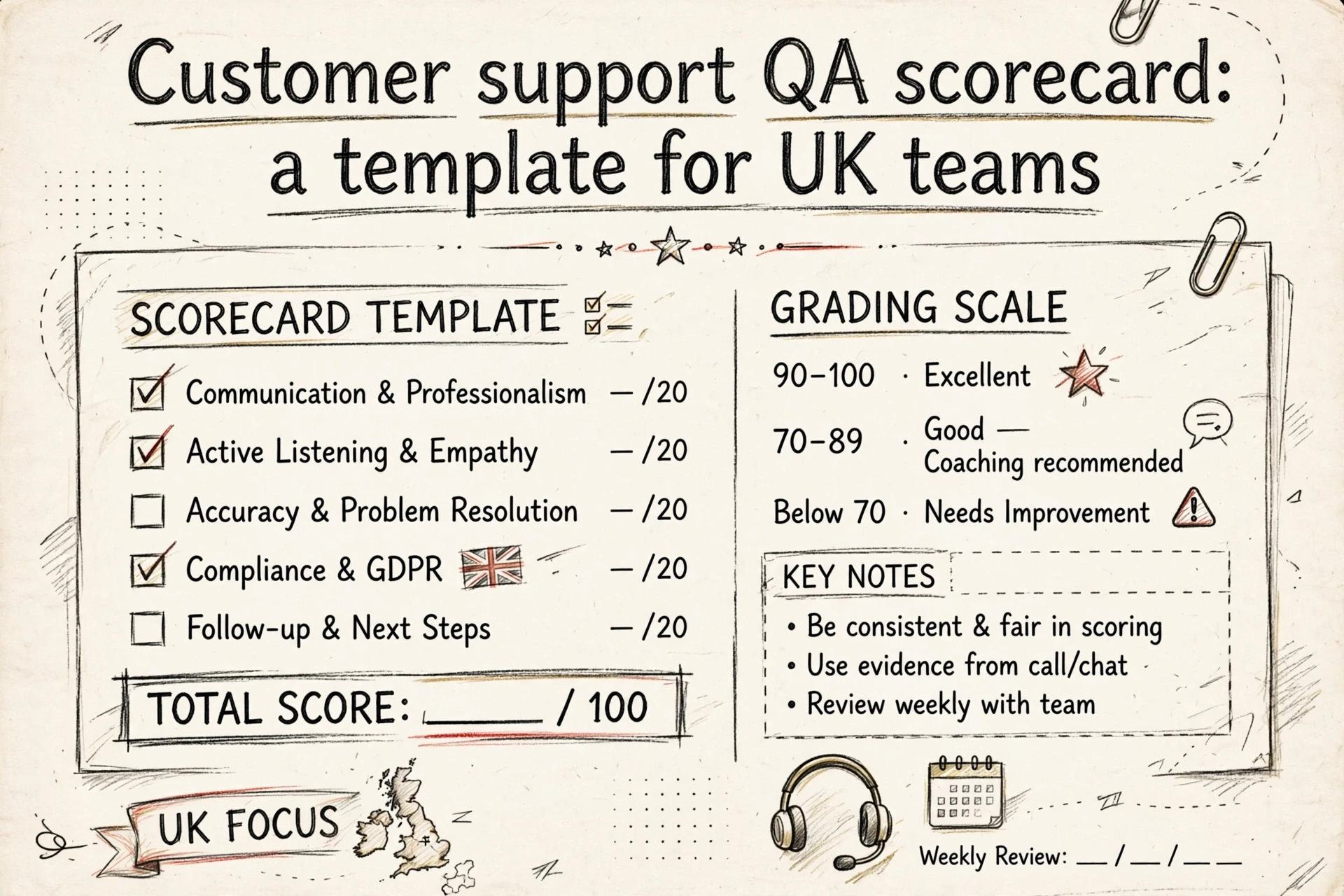
Quick Summary: This customer support QA template uses five weighted criteria adding to 100 points. Two fictional interactions show the calculation and a separate critical-failure gate. Copy the blank record, agree the rules with your team, calibrate reviewers and use the evidence for coaching.
A South African support agent can write a warm, fluent reply to a UK customer and still fail QA if the answer misses the refund rule, exposes unnecessary personal data or leaves the next step unclear. That gap between “sounded good” and “did the job right” is what a customer service quality assurance scorecard exists to close. This customer support QA template gives you weighted criteria, critical-failure rules and two scored example tickets, so every reviewer grades the same way. It also covers sampling, calibration and fair dispute handling for remote teams working UK hours. If you’re building a customer service quality monitoring process for staff hired through Hire SA Talent, start here.
Choose QA Criteria by Channel
A customer service quality assurance scorecard only works if the criteria match the channel. Email is judged on writing; live chat on pace and multitasking. Keep one core standard, then swap the channel-specific items.
Email Criteria
Email is asynchronous, so accuracy and structure carry the most weight. Score these:
- Correct, complete answer – did it solve the problem on the first reply?
- Clarity and structure – short paragraphs, no jargon, a clear next step.
- Tone and grammar – professional, on-brand, error-free.
- Correct use of templates – personalisation added, no copy-paste mismatch.
Assess the response against what the agent could reasonably know and do at that point. An unresolved issue may need a correct escalation rather than an immediate fix.
Live-Chat Criteria
Chat is fast and often concurrent. Weight pace and forward movement:
- Response speed – greetings and gaps within your agreed limits.
- Progress without repetition – the issue moves forward each message.
- Clarity under pressure – plain answers, correct facts, no copy-paste errors.
- Proper handover – clean escalation with context attached.
Define the expected acknowledgement and update windows in your own service policy. Do not reward speed when the answer or data handling is wrong.

Also Read: Hire South African Customer Support Uk
Build the Weighted Scorecard and Critical-Failure Rules
Use a 100-Point Weighted Model
A good customer service quality assurance scorecard weights criteria by what actually costs you customers. Accuracy matters more than spelling, so weight it higher.
| Criterion | Points | What good looks like |
|---|---|---|
| Accuracy of answer | 30 | Correct, complete resolution |
| Tone and empathy | 20 | Warm, on-brand, no jargon |
| Process compliance | 20 | Right steps, tags, notes |
| Clarity and structure | 15 | Short sentences, clear next step |
| Speed and follow-up | 15 | Promises kept, no dead air |
The examples below use these same weights for both channels so the calculations are comparable. You may adopt separate channel versions later; record the version and do not compare totals across different weight sets without explaining the difference.
Calculate each contribution as weight × score ÷ 5. Use 0–5: 0 means no acceptable evidence, 3 meets the written standard, and 5 shows the strongest defined performance. Write anchors for each criterion before using the sheet. Scores between anchors need a short explanation.
Apply Critical-Failure Gates
A critical-failure gate is a policy decision for your business, separate from the weighted calculation. For this illustrative template, a confirmed gate sets the final QA score to 0 while preserving the raw score for coaching.
Example gates, subject to your written policy:
- Unauthorised disclosure of sensitive customer information.
- A payment or refund executed without required authority.
- Abusive or discriminatory treatment.
A missing tag or ordinary note-taking error should normally affect the relevant criterion rather than automatically zeroing the whole interaction. A QA gate is not a legal finding: report suspected security incidents through the agreed process.
Log the evidence and the specific rule. If several agents fail the same rule, investigate the instructions, training and tools before drawing conclusions. Our remote team management guide covers wider ownership and escalation.
Copyable blank QA record
Ticket reference: [ ]; channel: [ ]; agent reference: [ ]; reviewer: [ ]; date: [ ]; scorecard version: [ ].
| Criterion | Weight | Score 0–5 | Weighted points | Evidence / coaching action |
|---|---|---|---|---|
| Accuracy | 30 | [ ] | [ ] | [ ] |
| Tone and empathy | 20 | [ ] | [ ] | [ ] |
| Process compliance | 20 | [ ] | [ ] | [ ] |
| Clarity and structure | 15 | [ ] | [ ] | [ ] |
| Speed and follow-up | 15 | [ ] | [ ] | [ ] |
| Raw total /100 | 100 | – | [ ] | [ ] |
Critical gate triggered: [none / rule and evidence]. Final score: [ ]. Agent response: [ ]. Agreed action, owner and review date: [ ].
Score Two Interactions: Email and Live Chat
The two fictional examples below use the same weights and scale. Assume the timing and data-handling expectations were explained to both agents in advance.
Worked Fictional Email Example
A UK customer emails about a duplicate charge. Thandi replies in 4 hours, confirms the refund, but forgets the required refund reference number.
| Criterion | Weight | Score 0–5 | Weighted points |
|---|---|---|---|
| Accuracy | 30 | 5 | 30 |
| Tone and empathy | 20 | 4 | 16 |
| Process compliance | 20 | 2 | 8 |
| Clarity and structure | 15 | 4 | 12 |
| Speed and follow-up | 15 | 5 | 15 |
| Total | 100 | – | 81 |
For this example, the refund was authorised and completed correctly; the missing reference is a documentation error. No critical gate applies. The final score is 81/100, with coaching on the missing reference. Your own policy should decide what follow-up that score requires.
Worked Fictional Live-Chat Example
Sipho resolves a login issue but posts sensitive payment details into a chat visible to an unauthorised recipient. In this fictional scenario, the company’s disclosure gate has been confirmed.
| Criterion | Weight | Score 0–5 | Weighted points |
|---|---|---|---|
| Accuracy | 30 | 5 | 30 |
| Tone and empathy | 20 | 4 | 16 |
| Process compliance | 20 | 0 | 0 |
| Clarity and structure | 15 | 4 | 12 |
| Speed and follow-up | 15 | 5 | 15 |
| Raw total | 100 | – | 73 |
The raw result is 73/100, but the confirmed critical gate makes the final QA score 0/100. Preserve both values and escalate the incident to the appropriate owner. A scorecard does not determine whether regulatory reporting is required.
Set Sampling and Reviewer Calibration
A scorecard only works if you pick the right tickets and your reviewers score them the same way. Get both wrong and your numbers are noise.
Separate Representative and Targeted Samples
Separate two sampling purposes:
- Random sample: select interactions without choosing only good or bad outcomes. A small pilot might begin with 4–8 per agent, but that is a starting workload, not a statistically representative estimate of overall performance.
- Targeted sample: inspect complaints, escalations, repeat contacts or other risk signals to investigate specific problems.
Report these separately. Combining targeted problem tickets with random tickets can distort comparisons between agents. Review sample size against volume and risk, and avoid making high-stakes decisions from a handful of scores.
Run Evidence-Led Calibration
As a pilot, ask reviewers to score the same three to five tickets independently every fortnight. Compare each criterion and the cited evidence. Differences may reflect unclear anchors, different information or reviewer judgement; investigate before changing a score.
Agree your own tolerance for reviewer differences and record it with the scorecard version. Resolve disagreements about critical gates before using the results in performance discussions.

Turn Scores into Coaching and Fair Dispute Handling
Give Evidence-Based Feedback
Give feedback promptly enough that the context is still useful. Show the ticket evidence, explain the criterion and agree one action to practise. Use relevant positive examples too. Set a review date and check whether the action helped; a number by itself is not a coaching plan.
Handle Disputes Without Diluting the Standard
Let agents push back – it protects fairness and catches scoring errors. Use a simple four-step protocol: name the criterion, quote the evidence, show the policy it was measured against, then invite their side. If they’re right, change the score; if they’re not, you’ve still shown the reasoning. Log every dispute and review patterns at calibration, since repeat disputes often flag an unclear criterion rather than a difficult agent.
Also Read: Ecommerce Retail
Roll Out the Scorecard with a South African Support Team
Pilot, Explain and Version the Standard
Run the scorecard on ten interactions first. Review two weeks of tickets, score them together, and compare your marks. Disagreements show which criteria need clearer wording. Explain every weighted element to the team, then version the sheet (v1.0, v1.1) so agents know exactly which standard applies.
Agents should never be surprised by criteria mid-quarter. Change the sheet, tell them, then apply it to new tickets only.
Clarify UK, EOR and Service-Provider Responsibilities
The UK business should name the operational owner of quality standards and feedback. Hire SA Talent introduces UK businesses; SA Konexion delivers recruitment and employment services under the agreed arrangement. Confirm employment responsibilities with the contracted employer, and use the appropriate process for any employment decision.
For wider context on how these structures work, our guides to hiring South African customer support and managing a remote team cover the employment layers in more detail.
Use the scorecard alongside a clear customer support role brief so expectations are explained before the first ticket is reviewed.
Frequently Asked Questions
How is a weighted QA score calculated?
Multiply each criterion’s weight by its score divided by 5, then add the results. The five weights in this template total 100; a confirmed critical gate is recorded separately and sets the final score to zero in this example.
Should a missing ticket tag automatically fail the interaction?
Not in this template. Ordinary documentation errors affect the process score. Reserve critical gates for the serious events your written policy defines, and record evidence before applying them.
How many tickets should each reviewer sample?
Choose a workload appropriate to volume and risk. A few pilot tickets help test the scorecard, but do not establish a representative performance estimate. Keep random samples separate from targeted investigations.
Can an agent dispute a QA score?
Yes. Record the criterion, evidence, agent’s explanation and review outcome. Correct scoring mistakes and use repeated disagreements to improve the written anchors.
Conclusion
Start with a versioned scorecard, written evidence anchors and a small pilot. Keep random and targeted samples separate, calibrate reviewers and allow agents to challenge errors. In the worked examples, the email receives 81/100; the chat receives a raw 73/100 and a final 0 after a confirmed critical gate. That distinction keeps the calculation and the reason for intervention visible.