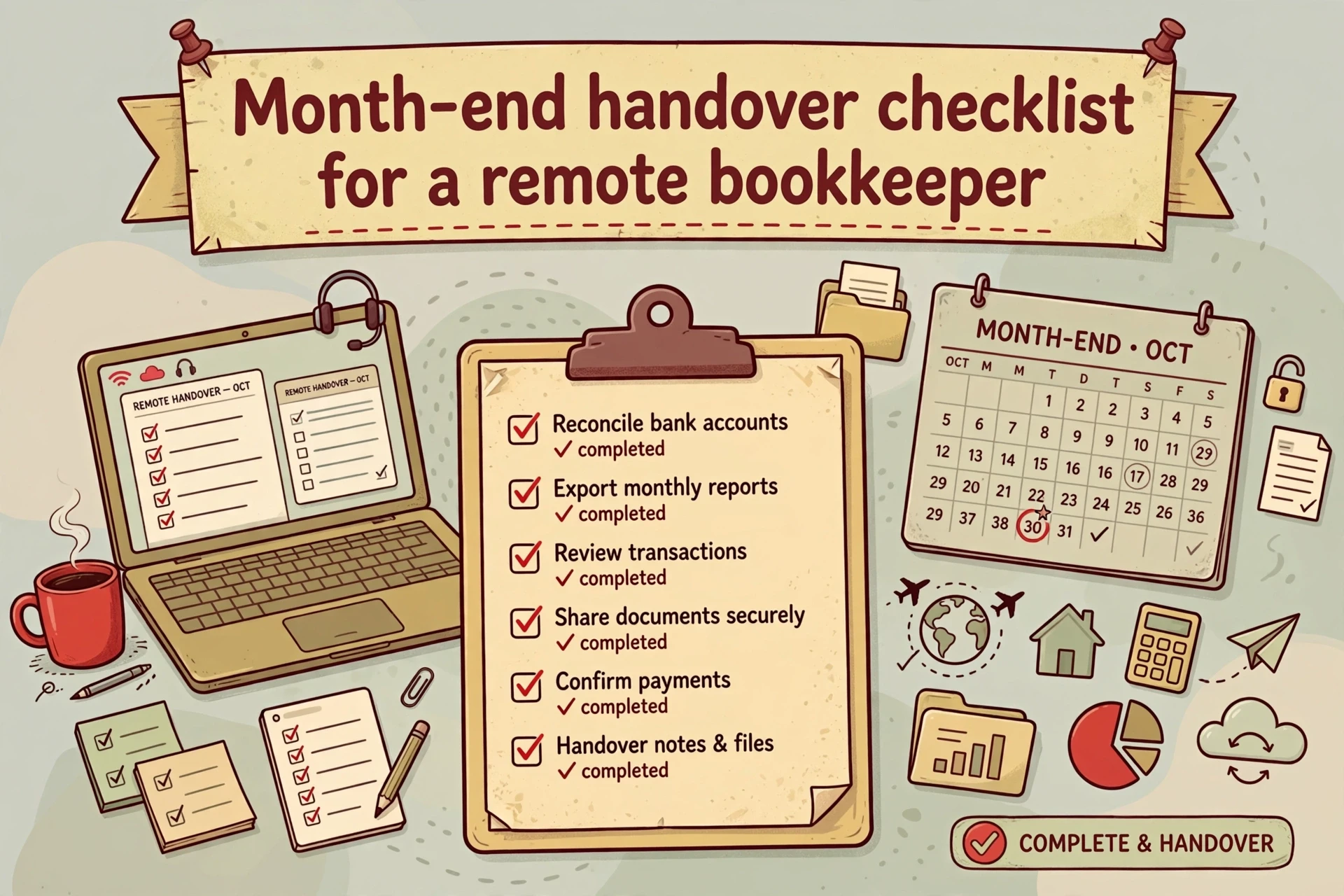
Quick Summary: A structured month-end handover checklist for remote bookkeepers prevents confusion by splitting roles among preparer, reviewer, and accountant, and using a pre-close access checklist plus an exception register with owners and deadlines. The handover pack, a single table with evidence, owner, and status columns, ties everything together, and a worked fictional example shows how to log unresolved items like an unexplained credit card charge instead of forcing a match. Approvals must be dated, access cleaned up after close, and open exceptions carried forward monthly. This process, recommended for UK businesses using South African bookkeepers, turns a chaotic close into a repeatable routine.
When your South African remote bookkeeper finishes the bank reconciliations on Friday, you should not have to dig through messages to work out which balance is final, which item is still open and who signs off next. Yet that is exactly what happens when there is no structured handover. This remote bookkeeper month end handover checklist fixes that. It gives UK businesses a clear split between preparer, reviewer and accountant roles, a pre-close access and evidence checklist, and an exception register that shows outstanding items at a glance. You also get a bookkeeper handover template with owner and deadline columns, plus a completed fictional example you can copy. Treat it as the month end close checklist that sits behind your broader process for managing remote staff. If you are still deciding whether to hire, start with our guide to hiring a South African bookkeeper for UK businesses.
Step 1: Set the Handover Roles and Review Boundary
Agree responsibilities before close: the bookkeeper prepares the specified records, a named reviewer checks them, and an accountant advises on technical or tax questions where that is part of their engagement. This is an operational handover template; adapt the accounting checks with your finance lead.
Define the Preparer, Reviewer and Accountant
The preparer records transactions, performs agreed reconciliations and flags questions. The reviewer checks the work against your documented close procedure. Where practical, separate preparation from approval; if your small team cannot do that, ask your finance lead to define an appropriate compensating review. Record who decides any unresolved accounting treatment.
Agree What Counts as Ready for Review
Define ‘ready for review’ as a complete evidence pack with reconciliations prepared, differences explained or logged, and unresolved items assigned. An exception can remain open at handover if the reviewer can see its significance, owner and next action. It should never be hidden by a tick marked ‘done’.
Also Read: Professional Services
Step 2: Complete the Pre-close Access and Evidence Checklist
Before any reconciliations start, confirm your remote bookkeeper has the records and access they need. This check makes missing inputs visible before the review deadline.
Check Accounts, Statements and Source Records
Run through this list before day one of close:
- Bank statements downloaded or shared for every account
- Credit card statements available
- Supplier invoices and receipts filed in your shared folder
- Payroll summary and pension contributions ready
- Sales reports exported, including any payment processor payouts
- Previous month’s handover pack available for reference
Your bookkeeper should confirm each item, not assume it exists. Give missing records an owner and a date rather than assuming they will arrive.

Confirm Access Without Sharing Credentials
Use named accounts, appropriate permissions and multi-factor authentication where available. Keep credentials out of the handover pack. If a system lacks suitable delegation, ask the system owner to agree an authorised access method consistent with its terms and your security policy. Record access approvals and remove permissions when they are no longer needed.
Step 3: Reconcile, Record Exceptions and Carry Forward Outstanding Items
Document Each Reconciliation
For each account within the agreed close scope, document how the ledger and statement balances reconcile, including timing differences and adjustments awaiting approval. Investigate unexplained differences; do not force a match or post an unsupported adjustment merely to complete the checklist.
For each account, save one reconciliation note. It should show:
- The statement date and closing balance
- Timing items, such as outstanding payments and deposits still clearing
- Bank-only items booked late, like fees or interest
- The final adjusted balance for both sides
The reviewer should be able to trace the reconciliation to the relevant records. Keep the explanation and source documents together, and identify which adjustments have been approved.

Use an Exception Register Instead of a Message Thread
Some items will not resolve by close day: an unreceipted card spend, a customer refund still pending, a supplier statement that never arrived. Do not bury these in WhatsApp or a long email chain. Log each one in an exception register with a description, value, owner and deadline. Anything unresolved gets carried forward to next month’s register, so nothing quietly disappears. This also gives your accountant a clean list of open items instead of scattered screenshots, and lets the reviewer identify issues requiring attention alongside the wider checks in the close procedure.
| Item | Value | Owner | Deadline | Status |
|---|---|---|---|---|
| Missing VAT receipt, stationery order | £84.20 | Bookkeeper | 5th | Chasing supplier |
| Unmatched Stripe payout | £1,112.00 | Reviewer | 3rd | Under review |
Also Read: Remote Team Management Guide
Step 4: Assemble the Handover Pack with Owners and Deadlines
The handover pack is one document, sent once, with a clear structure. It tells your UK reviewer what was done, what is still open, who owns each item, and when it is due. Without it, month-end becomes a chain of WhatsApp questions.
Blank Handover Pack Template
Copy this structure into your shared drive or project tool and fill it in each month:
| Deliverable / account | Evidence link and period | Preparer | Reviewer | Due date | Status / exception reference |
|---|---|---|---|---|---|
| [ ] | [ ] | [ ] | [ ] | [ ] | [ ] |
| [ ] | [ ] | [ ] | [ ] | [ ] | [ ] |
| [ ] | [ ] | [ ] | [ ] | [ ] | [ ] |
Use statuses such as not started, prepared, in review, approved and exception outstanding. Give every required task an owner; escalate missing ownership instead of dropping the task. Record the pack version and the period it covers.

How the UK Reviewer Should Use the Pack
- Open the pack on working day 1 and confirm the evidence links work.
- Check every “Open” item has an owner and a date before you leave for the day.
- Complete the review specified by your finance lead, taking account of risk and materiality; a single spot check is not a substitute for the required checks.
- Note anything missing in the exception register rather than emailing ad hoc questions.
This gives you a repeatable review routine and a full audit trail for your accountant.
For broader routines around managing remote finance staff, see our remote team management guide, and for hiring context, our bookkeeper hiring page.
Step 5: Review a Worked Fictional Handover
Completed Fictional Handover Table
Here’s how a finished pack looks. Thandi, a remote bookkeeper, hands over April to James, the finance director of a UK design studio.
| Item | Status | Evidence | Owner | Deadline | Notes |
|---|---|---|---|---|---|
| Bank reconciliation | Complete | Reconciliation report PDF | Thandi | 3 May | Balanced to £43,120 |
| Credit card reconciliation | Exception | Card statement + notes | James | 5 May | £92 unexplained charge |
| Supplier invoices posted | Complete | Ledger screenshot | Thandi | 2 May | 34 invoices |
| Payroll journal | Complete | Payroll report + journal | Thandi | 4 May | Matches PAYE summary |
| VAT control account | In review | Draft return figures | James | 6 May | Awaiting approval |
| Debtor chase list | Complete | Aged debtors report | Thandi | 3 May | 3 invoices overdue |
What the Example Shows
This fictional table illustrates an exception trail. Thandi records the unexplained £92 charge and passes it to James with a deadline instead of making an unsupported adjustment. ‘Complete’ here means preparation is complete; approval remains a separate dated step. Your finance lead decides the checks and evidence required.
Step 6: Close Approvals, Secure Access and Next-month Follow-up
Record Review, Approval and Period Status
The named reviewer records what was checked, the decision, date and any conditions or outstanding items. Keep preparation and approval distinct where possible. If the finance lead decides to lock a period, record who can authorise later corrections and how those changes will be documented. A locked period does not remove the need to resolve open exceptions.
Review Access and Create Next-month Actions
Review temporary access and remove permissions that are no longer needed, while retaining legitimate access to historical records and following your retention policy. Open next month’s checklist with every unresolved exception carried forward. Set a risk-appropriate access review date rather than assuming all staff use the same routine.
Tip: log approval dates, not just ticks. A dated sign-off is what makes your close defensible months later.
For recruitment context, Hire SA Talent’s bookkeeper page explains the role. Hire SA Talent introduces UK businesses; SA Konexion delivers recruitment and employment services under the agreed arrangement.
Frequently Asked Questions
What belongs in a bookkeeper’s month-end handover?
Include the period, agreed deliverables, evidence links, preparer, reviewer, deadlines, approval status and open exceptions. Keep a versioned pack so the reviewer can identify what changed.
What should happen to an unexplained difference?
Record it with the amount, evidence, owner and next action. Escalate under the agreed close procedure; do not post an unsupported adjustment just to force the balance.
Who approves the finished pack?
The person named in your finance process approves the relevant work. The accountant’s involvement depends on their engagement; this checklist does not assign tax or filing duties automatically.
Should access to prior months be removed after every close?
Remove access that is no longer authorised or needed. Preserve legitimate historical access and required records under the finance and security policies.
Conclusion
A useful handover lets the reviewer trace each deliverable to evidence, ownership and a decision. Keep the blank pack and exception register together, confirm the review responsibilities and carry outstanding work forward. Use our remote team management guide for the wider communication routine. The process still needs active review each month.