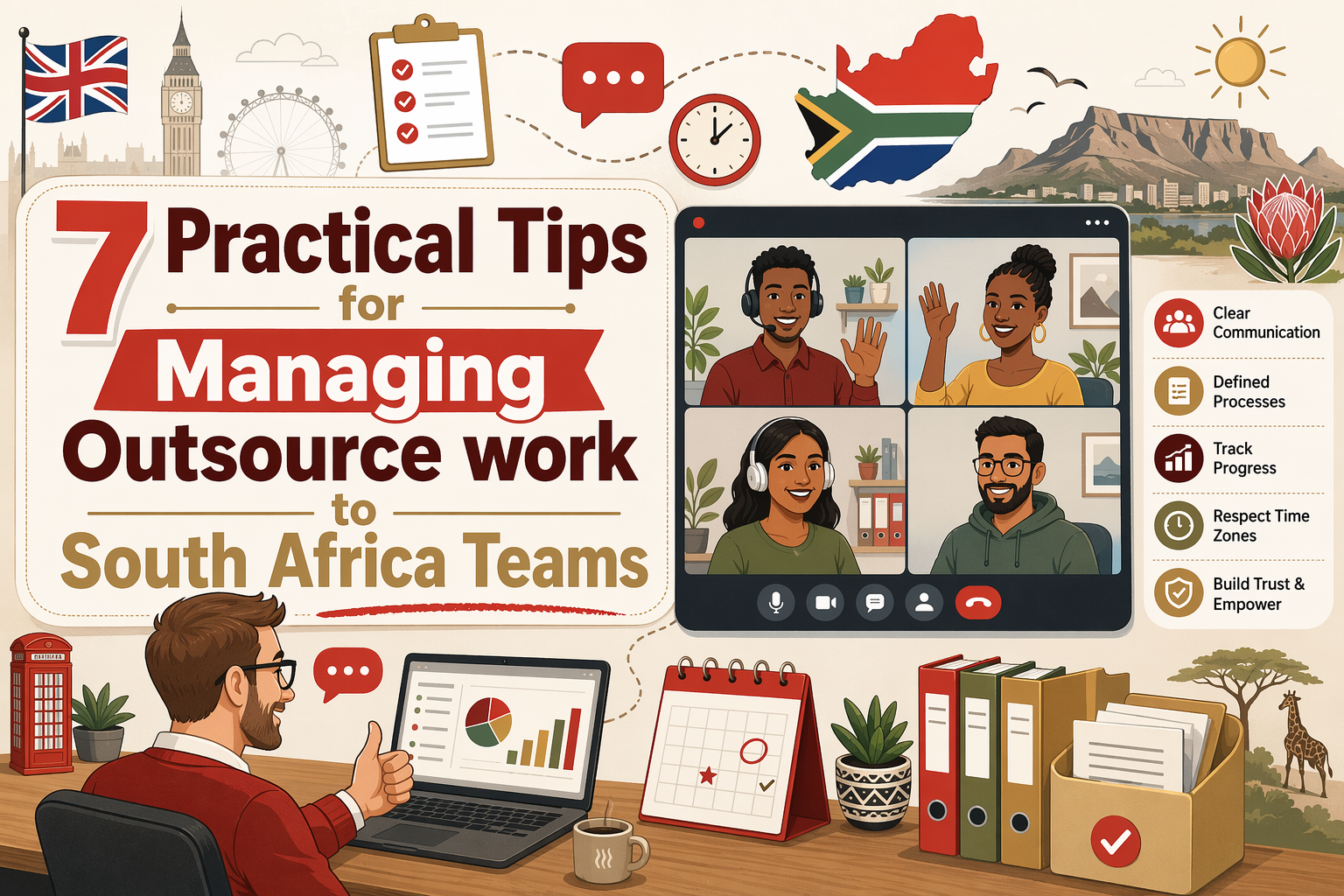
Quick Summary: Managing outsource teams in South Africa works best when you clearly define roles, build strong onboarding, and establish regular communication. Focus on outcome-based KPIs and choose the right employment structure to stay compliant. Regular feedback and a tailored setup based on the role help ensure steady delivery and team stability.
If you are outsourcing from the UK to South Africa, your results depend more on how you manage the setup than on the hire itself. Many firms like the lower cost, strong English, and close time overlap. Problems start when roles are unclear, onboarding gets rushed, and day-to-day communication slips.
That is where practical Outsource Work Tips matter. The right Outsource Work Tips help you set clear expectations, keep delivery steady, and avoid small issues turning into missed deadlines. These Outsource Work Tips are built for UK firms working with South Africa Teams in outsourced or embedded remote roles.
This guide focuses on the Outsourcing Tips that usually make the biggest difference first. We picked them based on what most affects delivery quality and ease of management: role design, onboarding, communication, KPIs, compliance, feedback, and retention. Use these Outsource Work Tips to build a model that is efficient, compliant, and easier to scale.
Quick Comparison
| Tip | Best for | Main focus | Primary risk if ignored | Typical result |
|---|---|---|---|---|
| Define the role before you outsource | Preventing confusion and scope creep | Role design and expectations | Misalignment and rework | Cleaner hiring and stronger delivery |
| Build a strong onboarding process | Faster ramp-up and fewer mistakes | Training and systems setup | Slow start and inconsistent output | Quicker productivity |
| Set a communication rhythm that works across time zones | Keeping UK and South Africa teams aligned | Cadence and collaboration | Delays and duplicated work | Faster decisions and fewer misunderstandings |
| Measure outputs, not just activity | Accountability and performance | Results tracking | Busy work without business value | More predictable delivery |
| Choose the right hiring and compliance structure | Reducing legal and payroll risk | Employment structure | Misclassification and compliance issues | Safer, more scalable hiring |
| Give feedback early and often | Improving quality over time | Coaching and review | Repeating avoidable mistakes | Better standards and confidence |
What to know about outsourcing to South Africa
South Africa gives UK businesses a practical way to add skilled remote staff without fighting big time-zone gaps or major language barriers. You get strong English-speaking talent and solid overlap with UK working hours across support, ops, finance, sales, marketing, and IT.
The setup works well when you treat the team as part of your business, not a separate supplier. Clear roles, simple workflows, and regular check-ins matter more than cheap rates.
The best results come when you hire for a defined job, set clear targets, and manage performance day to day.
That matters even more now, as UK firms need flexible hiring, tighter cost control, and dependable delivery without slowing growth.
1. Define the role before you outsource
Clarity first, outsourcing second. The best South Africa Teams do well when the role is tight from day one, with clear work, hours, tools, reporting lines, and success markers. SHRM notes that a job description should clarify tasks, duties, responsibilities, and performance expectations, not just list random tasks.

Highlights
- Write the role as outcomes, not just tasks.
- Split must-have work from nice-to-have work.
- Name who gives direction and who signs off work.
- Match the role to a repeatable process, not a messy catch-all problem.
- Set 30, 60, and 90-day success checks. Clear early goals help remote hires ramp faster, as shown in SHRM’s advice on setting expectations early and defining outcomes.
Specs
- Best for: Preventing confusion and scope creep
- Main focus: Role design and expectations
- Primary risk if ignored: Misalignment and rework
- Typical result: Cleaner hiring and stronger delivery
Pros
- Makes hiring faster and more accurate
- Helps managers assign work confidently
- Improves quality and accountability
Cons
- Requires upfront planning
- Can take time to document properly
This ranks here because every other management step depends on a clear role.
Last updated: June 30, 2026
Also Read: A Uk Smes Cost Saving Journey With A South African Remote Team
2. Build a strong onboarding process
A structured start pays off later. South Africa teams do better when onboarding is planned, not improvised.
Highlights
- Share SOPs, templates, and examples of strong work on day one.
- Set up tools and permissions before day one, as Remote recommends.
- Use a first-week checklist with clear milestones and a named buddy.
- Explain communication rules, escalation paths, and what “done” looks like.
Specs
- Best for: Faster ramp-up and fewer mistakes
- Main focus: Training and systems setup
- Primary risk if ignored: Slow start and inconsistent output
- Typical result: Quicker productivity
Pros
- Reduces early-stage friction
- Improves confidence and retention
- Creates consistency across hires
Cons
- Needs upfront manager time
- May require documentation you do not yet have, including 30-60-90 milestones
This ranks high because strong remote onboarding cuts avoidable errors early.
Last updated: June 30, 2026
Also Read: Hire a South African Virtual Assistant for UK Businesses
3. Set a communication rhythm that works across time zones
South Africa teams work well for UK firms because the time gap is small. London is usually just 1 hour behind Johannesburg in BST, which gives you strong same-day overlap for calls and fixes according to Timeanddate. Use that overlap well, but do not fill it with meetings.

Highlights
- Set one channel for each job – Slack for quick questions, email for formal updates, and project boards for task status.
- Agree reply times for urgent and non-urgent work.
- Keep 1 to 2 overlap hours for live decisions.
- Write key decisions down, since South Africa stays 1-2 hours ahead of the UK through the year as this time comparison shows.
Specs
- Best for: Keeping UK and South Africa teams aligned
- Main focus: Cadence and collaboration
- Primary risk if ignored: Delays and duplicated work
- Typical result: Faster decisions and fewer misunderstandings
Pros
- Uses time-zone overlap well
- Cuts back-and-forth
- Helps real-time problem solving
Cons
- Needs discipline from both sides
- Gets messy without rules
This ranks here because clear cadence often decides whether outsourced teamwork feels smooth or frustrating.
Last updated: June 30, 2026
4. Measure outputs, not just activity
Track results that matter. If you manage South Africa Teams by who looks busiest, you will get busy work. Better control comes from clear output goals like deadlines, accuracy, response times, and customer impact. South African research on remote performance management highlights clear expectations and deliverable tracking, while another South African study found remote staff can work longer hours just to prove they are productive.

Highlights
- Choose 3 to 5 KPIs that fit the role
- Review results on a fixed schedule
- Balance speed with quality and customer experience
- Use simple dashboards or trackers
Specs
- Best for: Accountability and performance
- Main focus: Results tracking
- Primary risk if ignored: Busy work without business value
- Typical result: More predictable delivery
Pros
- Creates objective performance talks
- Helps spot issues early
- Supports better workload planning
Cons
- Bad KPIs can drive the wrong behaviour
- Needs regular review
This ranks highly because outcome-based management cuts micromanagement and makes remote delivery easier to trust.
Last updated: June 30, 2026
Also Read: Comparing Employer of Record South Africa Services for UK Companies
5. Choose the right hiring and compliance structure
Get the employment setup right from the start. Not every South Africa team should sit under the same model, so match the structure to the work, control level, and length of hire. SARS tests whether someone is truly independent, and PAYE duties change if the role looks like employment under Interpretation Note 17 and its 2027 employer guide.
Highlights
- Check if the role is ongoing, managed daily, and tied to your core team
- Use contracts that fit the model you chose
- Review payroll, tax, and worker status before onboarding
- Use local help or an Employer of Record South Africa setup if you plan to scale
Specs
- Best for: Reducing legal and payroll risk
- Main focus: Employment structure
- Primary risk if ignored: Misclassification and compliance issues
- Typical result: Safer, more scalable hiring
Pros
- Improves legal clarity
- Supports long-term team building
- Simplifies payroll and HR administration
Cons
- May add service cost
- Requires early legal and operational decisions
This ranks here because the right setup prevents avoidable risk and makes growth far easier.
Last updated: June 30, 2026
Also Read: Home
6. Give feedback early and often
Small corrections stop bigger problems later. South Africa teams usually do better when feedback is quick, clear, and tied to real examples. Research on remote performance management in South Africa highlights continuous performance communication and clear expectations as key habits for managers in remote and hybrid teams.
Highlights
- Correct issues close to when they happen
- Use examples to show what good looks like
- Balance correction with recognition
- Keep feedback focused on the work, not the person
Specs
- Best for: Improving quality over time
- Main focus: Coaching and review
- Primary risk if ignored: Repeating avoidable mistakes
- Typical result: Better standards and confidence
Pros
- Builds trust through clarity
- Helps teams improve faster
- Keeps standards consistent
Cons
- Requires manager consistency
- Can feel subjective without examples
It ranks here because fast feedback improves quality, builds trust, and supports accountability in remote work.
Last updated: June 30, 2026
Honourable Mentions
One runner-up still matters because it affects team stability over time. 7. Plan for retention and growth – keep good people once you find them.
How to choose the right outsourcing setup
Pick the setup based on the role, not the trend. A once-off project needs one model. A daily, business-critical role needs another.
Use these criteria to choose:
-
Is the work ongoing or project-based?
Ongoing support, admin, finance, and sales roles need a structured setup with clear management, reporting, and routine check-ins. Short projects can sit under a simpler contractor model. -
Does the role suit South Africa’s strengths?
Pick roles that gain from strong English, UK-hours overlap, and repeatable processes. Customer support, admin, lead gen, finance support, and operations work usually fit well. -
Will they handle sensitive data?
If the person touches payroll, HR, finance, customer records, or internal systems, put compliance and employment structure first. That is where a managed route like Hire SA Talent can make more sense than a loose freelancer setup. -
Can success be measured clearly?
Project work needs fixed deliverables, deadlines, and owners. Embedded roles need KPIs, response times, and quality standards. -
How much management time do you really have?
Complex roles need strong onboarding, weekly cadence, and closer performance management.
If someone works inside your systems every day, treat them like part of your team, not a detached vendor.
Need a South African team that is easier to manage from day one? Hire SA Talent helps UK businesses hire dependable remote staff through a structured, compliant setup, so communication, onboarding, and day-to-day performance feel far smoother. If you want less hiring risk and better support, start there.
Frequently Asked Questions
Q1: What are the key strategies for effectively managing outsource teams in South Africa?
Set clear goals, role limits, response times, and reporting lines from day one. Use simple SOPs, regular check-ins, and shared KPIs. Match work to the right skill level, and manage outcomes, not hours.
Q2: How can UK businesses ensure compliance when outsourcing work to South African teams?
Use a compliant hiring route, clear contracts, data rules, and local payroll support. Check worker status, tax setup, and POPIA duties. Providers like Hire SA Talent can reduce risk by handling local employment properly.
Q3: What are the cost savings and quality benefits of outsourcing to South Africa for UK companies?
UK firms often cut hiring costs while getting strong English skills, solid service standards, and close time-zone overlap. South African teams work well in support, admin, finance, sales, and operations roles.
Q4: How do I know which roles should go to a South African remote team?
Start with repeatable, process-led roles first. Good fits include customer support, admin, lead follow-up, bookkeeping support, and back-office tasks. Keep high-risk legal or highly local roles in-house until your systems are mature.